


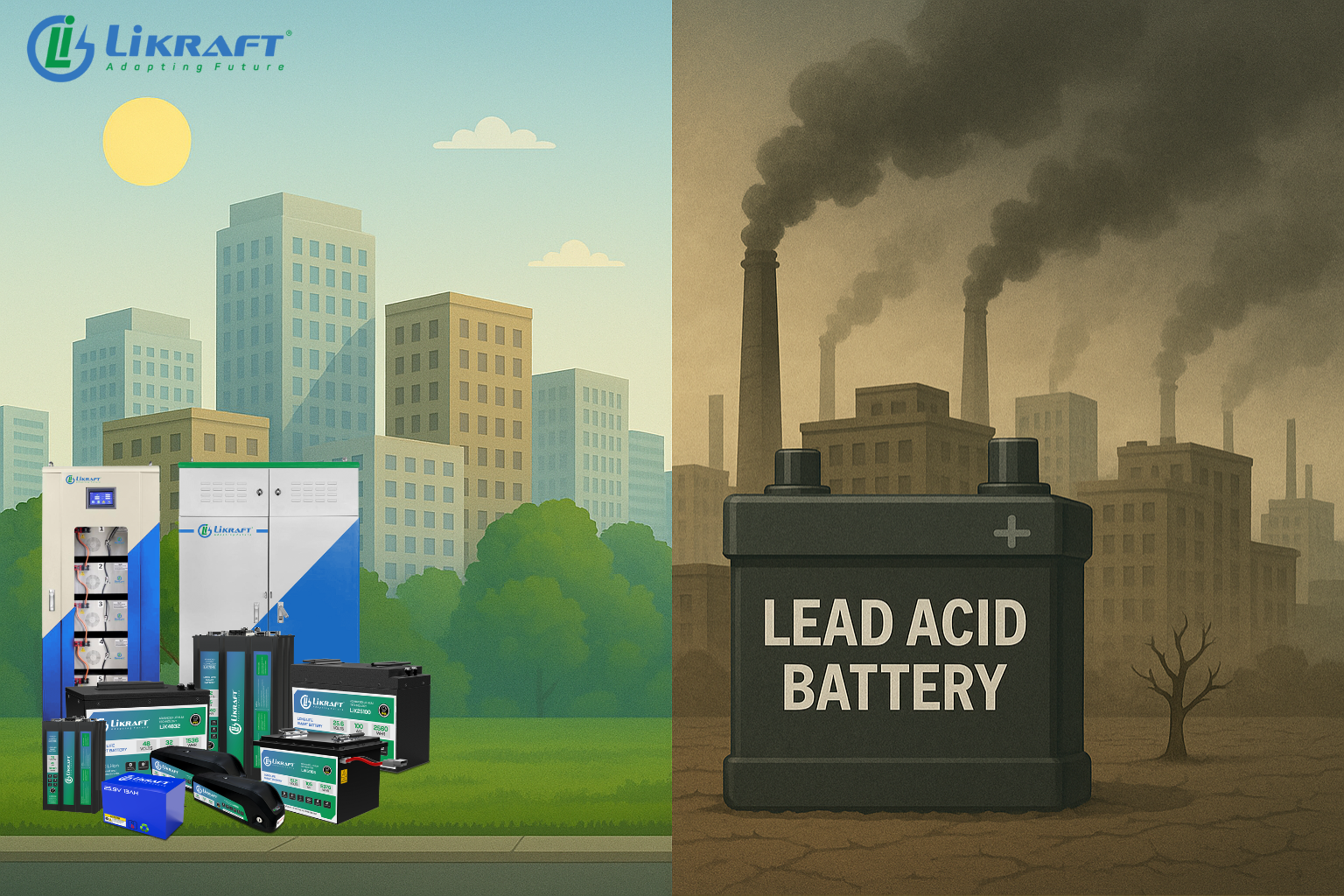
If you’re still choosing batteries the way we did ten years ago, you’re probably overpaying—either in money, maintenance, or downtime. Lead-acid batteries have been around for a long time, and they have indeed done their job. But power needs have changed. Faster cycles, tighter spaces, higher uptime expectations. This is exactly where lithium batteries take the lead.
Let’s break it down in plain terms.
1. More Usable Power, Less Wastage
A lead-acid battery may say 100 Ah on paper, but you realistically use only about 50–60% of that. Push it harder, and its life drops fast.
Lithium batteries are different. You get nearly 90–95% usable capacity without stressing the system. What this really means is simple: fewer batteries, smaller setups, and consistent performance from the first hour to the last.
For applications like solar storage, industrial backup, EVs, or telecom, that difference matters every single day.
2. Longer Life That Actually Pays Off
Lead-acid batteries typically last 1,000–1,500 cycles when properly maintained. Miss a few maintenance checks, and that number drops.
Lithium batteries comfortably cross 3,000–6,000 cycles depending on chemistry and usage. At Likraft, our lithium solutions are designed for long-term reliability, not short-term replacement.
Yes, lithium costs more upfront—but over its lifetime, it ends up being the cheaper option. Fewer replacements, fewer failures, fewer headaches.
3. Zero Maintenance, Zero Guesswork
Lead acid batteries demand attention: water topping, corrosion checks, ventilation planning, and constant monitoring.
Lithium batteries? Install them and move on.
With an integrated Battery Management System (BMS), Likraft lithium batteries automatically manage charging, discharging, temperature, and safety. No manual checks. No performance guessing. Just stable power when you need it.
4. Faster Charging, Higher Efficiency
Lead-acid batteries charge slowly and waste energy as heat. Lithium batteries charge faster and operate at much higher efficiency.
This makes a big difference in solar systems where charging windows are limited and in industrial setups where downtime costs money. Faster charging means quicker readiness—and better energy use overall.
5. Compact, Lightweight, and Space-Saving
Lead-acid batteries are bulky and heavy. As capacity increases, so does the space problem.
Lithium batteries deliver more power in a smaller footprint. Less weight, cleaner installations, and easier system expansion. For industries working with limited space—or mobile applications like EVs—this is a clear win.
6. Safer and More Stable Than You Think
There’s a lot of noise around battery safety. The truth is, modern lithium batteries—especially LFP-based systems—are extremely stable when designed correctly.
Likraft batteries are built with safety-first architecture, thermal protection, and intelligent controls. The result is a battery that doesn’t just perform well—it behaves predictably, even under demanding conditions.
7. Built for India’s Energy Reality
Indian power conditions aren’t always gentle—voltage fluctuations, high temperatures, and long operating hours are common.
Likraft lithium batteries are engineered and assembled in India for Indian conditions. From industrial estates to solar rooftops, our systems are designed to handle real-world usage, not lab-only scenarios.
The Bottom Line
Lead-acid batteries had their moment. Lithium batteries are built for what comes next.
If you’re looking for higher efficiency, longer life, lower maintenance, and smarter energy storage, lithium is the clear choice. And when it comes to reliable lithium solutions backed by real engineering, Likraft Batteries delivers power that lasts.
Because smart energy isn’t about short-term savings—it’s about long-term control.
Send us an email at info@likraft.com
Address: Rai Industrial Area, Sonipat, Haryana