


Lead-acid batteries dominated the vehicle, backup power, and solar markets for decades. They were affordable, readily available, and known. But with the advent of technology, their shortcomings became increasingly difficult to overlook. In 2025, lithium batteries from Likraft Batteries will have gone from “the new alternative” to the undisputed norm in industries like electric mobility, renewable energy, and telecom.
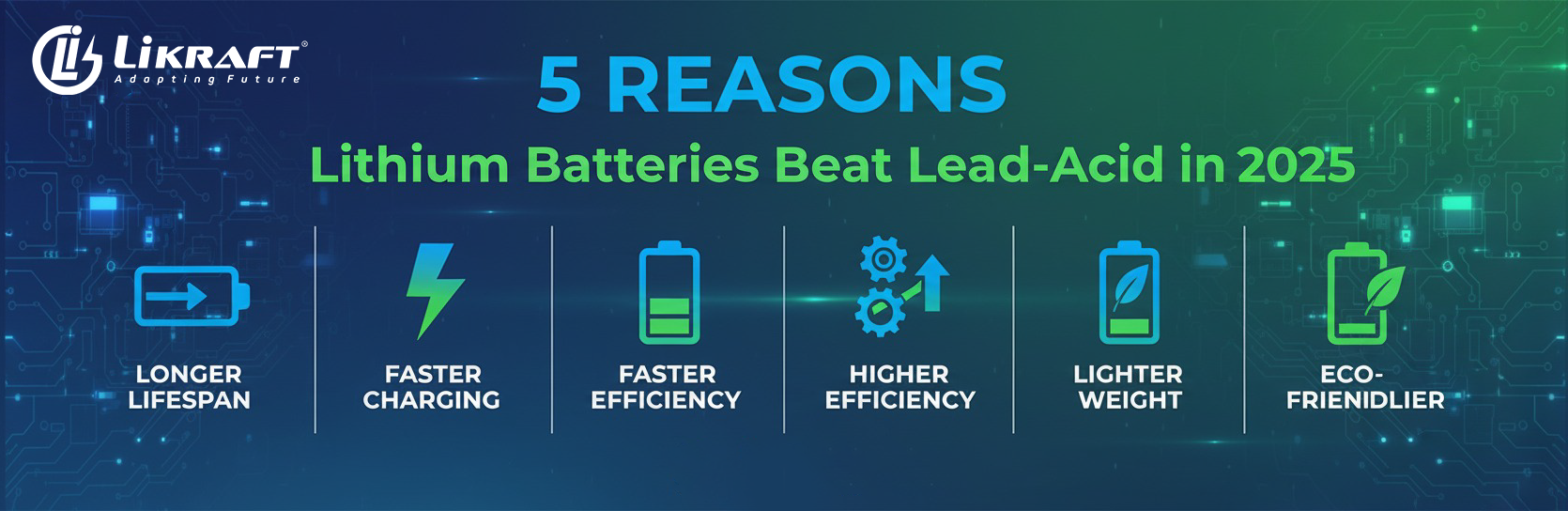
So why did lithium surpass lead-acid so convincingly? Let’s consider it broken down into five big reasons.
transitioned from being “the new alternative” to the clear standard across industries like electric mobility, renewable energy, and telecommunications
Lithium Batteries Last Much Longer
One of the worst things about lead-acid batteries is how short their lifespan is. A standard lead-acid unit will survive about 300–500 cycles, which most often translates to 2–3 years before it needs to be replaced. Lithium batteries from Likraft, meanwhile, can go 2,000–5,000 cycles based on use—often going far beyond 8–10 years.
That’s not convenience alone. It’s a longer life that translates to fewer replacement parts, less maintenance, and lower overall cost of ownership. It’s saving businesses and homeowners directly in time and dollars.
They Charge Faster
“Slow” is the typical term for lead-acid batteries. It takes 8–12 hours to charge them completely, and even that cannot be done with fast charging without shortening their life. This problem is eliminated by lithium batteries. With new battery charging systems from Likraft Batteries, they will reach 80% capacity in only 1–2 hours.
For electric cars, delivery fleets, or solar backup power, this pace equates to more time in operation and less waiting. In an efficiency-driven world, lithium’s rapid charge capability is a huge advantage.
Increased Energy Efficiency
Here’s the thing: you can’t use all of the energy you put into a battery. Lead-acid batteries are notoriously bad about this, with energy loss that only gives you 70–80% of the power you stored. Lithium batteries from Likraft, on the other hand, give you more than 95% efficiency.
That translates into less wasted energy, lower power bills, and increased performance in renewable energy systems. For solar, specifically, high efficiency means you get the maximum from every unit of sunlight absorbed.
Lightweight, Compact Design
Ask anyone who has ever had to pick up a lead-acid battery—it’s heavy and large. Lithium packs, on the other hand, weigh up to 70% less while carrying more usable power.
This is a big deal in applications such as EVs, where lighter batteries equal better range and handling. It’s also important in portable power configurations and home storage systems, where space can be an issue. Basically, Likraft lithium batteries pack more power into less space, and that’s a win no matter the direction.
Designed for Smart Technology
The future is digital, and batteries must play catch-up. Lithium batteries from Likraft Batteries are often packaged with Battery Management Systems (BMS) that sense temperature, voltage, and performance in real time. Numerous models also happen to be IoT-enabled, permitting remote monitoring and interaction with smart energy systems.
Lead-acid batteries just can’t hold their own in this regard. They don’t possess the intelligence and safety features required by today’s applications—whether it’s fleets of EVs, solar microgrids, or smart homes.
The Bottom Line
By 2025, the transition is clear: lithium batteries from Likraft have left lead-acid well behind. They are longer-lasting, faster to charge, more efficient in use, and designed for today’s and tomorrow’s smart energy systems.
For businesses and individuals, the question is now no longer “Should I switch?” but “Why am I still using lead-acid?”
If you’re planning your next EV upgrade, solar installation, or energy storage project, lithium from Likraft Batteries isn’t just the better choice—it’s the only one that makes sense in 2025.
Send us an email at info@likraft.com
Address: Rai Industrial Area, Sonipat, Haryana