


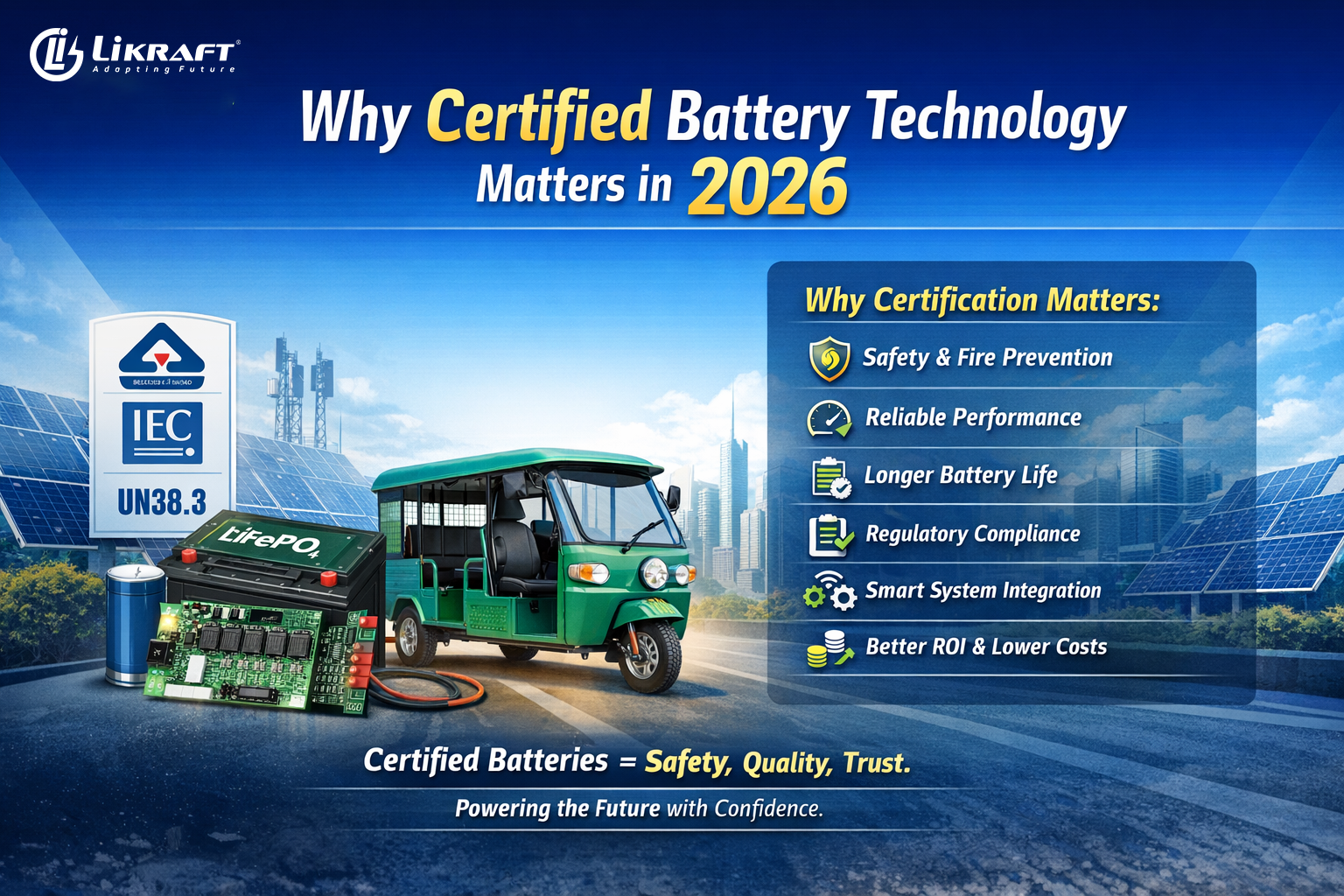
Technology is advancing fast—but not all progress is equal.
In 2026, lithium batteries are at the core of energy systems—powering homes, electric vehicles, industries, and critical infrastructure. But alongside this growth, one challenge is becoming more visible:
The gap between certified and non-certified battery technology.
At Likraft Batteries, we believe performance starts with trust—and trust comes from certification, testing, and engineering discipline.
The Shift From Backup to Dependency
Batteries are no longer just backup systems.
They are now responsible for:
- Daily energy storage
- Mobility solutions like E-Rickshaws and EVs
- Solar power utilization
- Industrial uptime
What this really means is simple:
Battery failure is no longer acceptable.
And that’s exactly where certified battery technology becomes critical.
What “Certified Battery Technology” Actually Means
Certification is not just a label.
It’s a validation that a battery has been tested across multiple safety and performance conditions.
A certified lithium battery typically complies with:
- BIS (Bureau of Indian Standards)
- IEC safety and performance standards
- UN38.3 transport safety testing
- ISO-certified manufacturing processes
These standards ensure the battery is designed, tested, and manufactured to perform safely under real-world conditions.
At Likraft Batteries, certification is integrated into the development process—not added later.
Why Certification Matters More in 2026
1. Safety Cannot Be Compromised
Lithium batteries operate at high energy density.
Without proper certification and testing, risks increase:
- Overheating
- Thermal runaway
- Fire hazards
- System instability
Certified battery systems are built with:
- Advanced protection mechanisms
- Controlled charging parameters
- Thermal management systems
This ensures safe operation across different environments.
2. Performance You Can Rely On
Uncertified batteries often show:
- Voltage drops
- Inconsistent backup
- Reduced efficiency over time
Certified batteries go through:
- Load testing
- Cycle testing
- Environmental testing
This results in:
- Stable output
- Predictable backup
- Consistent long-term performance
That’s the standard followed at Likraft Batteries.
3. Longer Battery Life
Battery lifespan depends on more than chemistry.
It depends on:
- Cell quality
- BMS precision
- Assembly standards
- Testing protocols
Certified batteries are engineered for:
- Higher cycle life
- Controlled depth of discharge
- Balanced cell performance
At Likraft Batteries, lithium battery systems are designed to deliver reliable performance over thousands of cycles.
4. Compliance Is Becoming Mandatory
In 2026, regulatory expectations are stricter.
For many applications—especially EVs, solar systems, and industrial use—certification is no longer optional.
Using non-certified batteries can lead to:
- Project rejection
- Compliance issues
- Insurance limitations
- Safety liabilities
Certified battery solutions ensure your system meets both current and future requirements.
5. Smart Systems Need Certified Integration
Modern energy systems are intelligent.
They rely on:
- Smart inverters
- EV controllers
- IoT-based monitoring
- Energy management systems
Certified batteries support:
- Advanced BMS communication
- System compatibility
- Real-time monitoring
At Likraft Batteries, lithium solutions are designed to integrate seamlessly with modern energy ecosystems.
6. Better Return on Investment
Initial cost is only one part of the equation.
What really matters:
- Battery lifespan
- Maintenance cost
- Downtime risk
- Replacement frequency
Certified batteries:
- Last longer
- Perform efficiently
- Reduce operational issues
This leads to a lower total cost of ownership over time.
How to Identify a Certified Battery
Before choosing a battery, verify:
- Is BIS certification available?
- Are IEC standards clearly mentioned?
- Has UN38.3 testing been completed?
- Is BMS protection defined?
- Is cycle life data transparent?
- Is the warranty clearly structured?
If these details are missing, the risk increases.
The Likraft Approach
At Likraft Batteries, certification is not treated as a requirement—it is treated as a responsibility.
Each lithium battery is developed with:
- Tested LiFePO₄ chemistry
- Advanced Battery Management Systems
- Strict quality control processes
- Compliance with industry standards
This ensures every battery delivers:
- Safety
- Performance
- Reliability
Conclusion
Certified battery technology is not about documentation.
It’s about assurance.
Assurance that your system will:
- Perform when needed
- Remain stable under load
- Operate safely over time
In 2026, as dependence on energy storage increases, the difference between certified and non-certified batteries becomes more critical than ever.
Choosing certified lithium solutions from Likraft Batteries means choosing long-term performance, safety, and trust.
Because in energy systems—
what you can’t see inside the battery matters the most. 🔋
Send us an email at info@likraft.com
Address: Rai Industrial Area, Sonipat, Haryana