


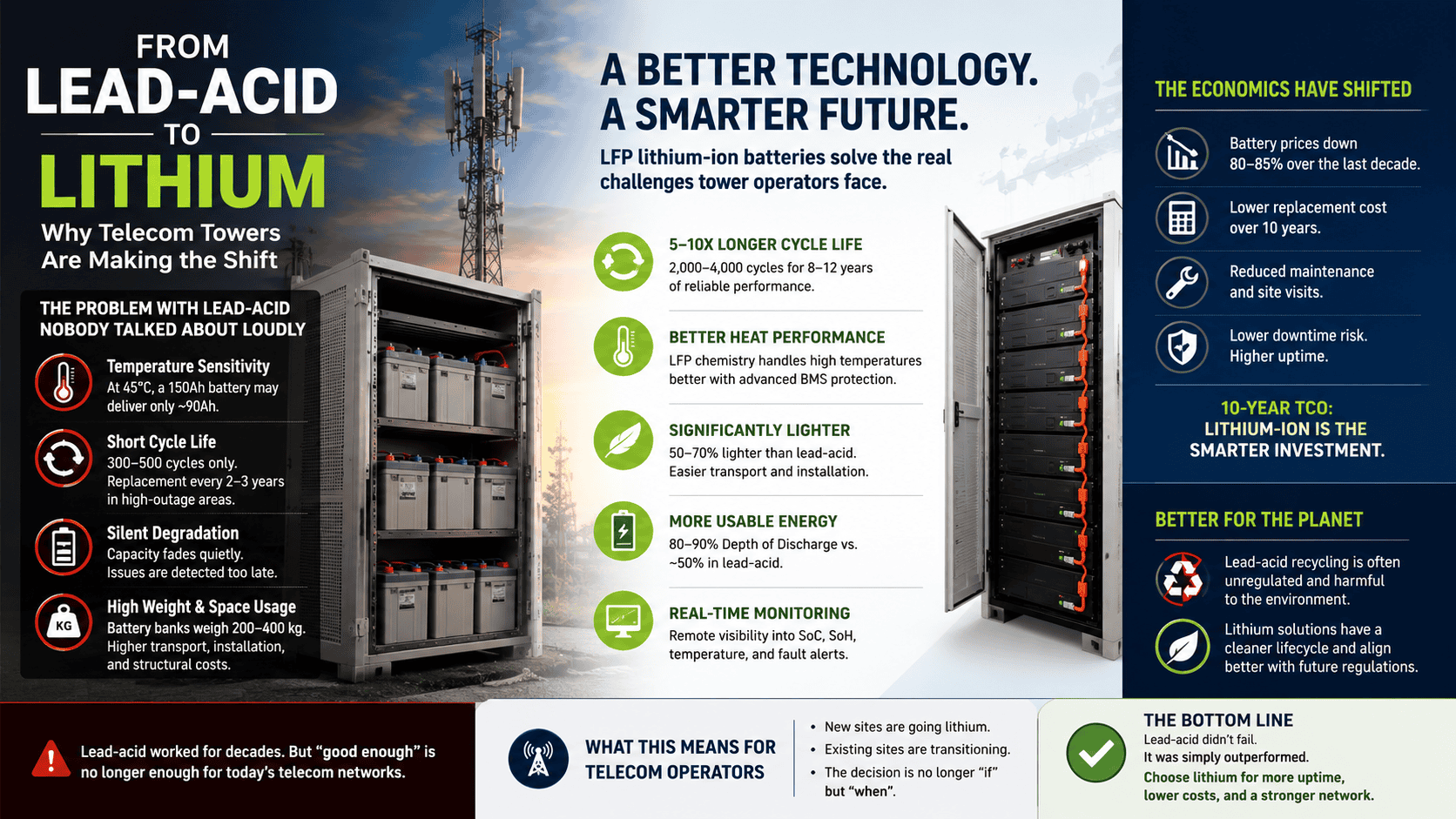
Walk up to a telecom tower site in 2018, and you’d almost certainly find a rack of heavy, vented lead-acid batteries sitting inside a cabinet.
They powered backup systems for decades—and no one really questioned it.
Fast forward to today—the picture has changed.
Lithium-ion batteries are replacing lead-acid at a pace the industry didn’t fully anticipate.
So what changed? And why does it matter for uptime, operations, and long-term costs?
The Hidden Limitations of Lead-Acid Batteries
Lead-acid batteries have always been functional—but telecom networks today demand more than “good enough.”
Here’s what operators were quietly dealing with:
1. Temperature Sensitivity
- Performance drops sharply in high temperatures
- At 45°C, a 150Ah battery may deliver only ~90Ah
- Critical during extended power outages
2. Short Cycle Life
- Typical life: 300–500 cycles
- In high-outage regions: replacement every 2–3 years
3. Silent Degradation
- Capacity loss happens gradually
- Failures are often detected too late
4. High Weight & Space Usage
- Battery banks weigh 200–400 kg
- Impacts:
- Transport costs
- Installation complexity
- Structural load on towers
What Lithium-Ion (LFP) Changes
Lithium-ion—especially LFP (lithium iron phosphate)—is designed for exactly these challenges.
1. 5–10x Longer Cycle Life
- 2,000–4,000 cycles
- Translates to 8–12 years of operation
2. Better Heat Performance
- Stable in high-temperature environments
- Supported by an advanced BMS (Battery Management System)
3. Significant Weight Reduction
- 50–70% lighter than lead-acid
- Easier logistics and installation
4. Higher Usable Capacity
- Lead-acid: ~50% Depth of Discharge
- Lithium: 80–90% usable energy
5. Real-Time Monitoring
- Remote visibility into:
- State of charge
- State of health
- Temperature
- Fault alerts
The economics have shifted.
For years, lead-acid stayed dominant for one reason: lower upfront cost.
That’s no longer true in practical terms.
Why Lithium Now Wins on Cost:
- Battery prices dropped 80–85% over the last decade
- Fewer replacements over the lifecycle
- Reduced maintenance visits
- Lower downtime risk
👉 10-year Total Cost of Ownership (TCO): Lithium-ion is now the smarter investment.
Regulatory & Environmental Reality
Lead-acid recycling exists—but often through unregulated channels, leading to the following:
- Environmental hazards
- Increased compliance pressure
Lithium solutions:
- Cleaner lifecycle profile
- Better aligned with future regulations
What This Means for Telecom Operators
The transition is already happening.
Current Industry Trend:
- New telecom sites → Lithium-ion by default
- Existing sites → Gradual replacement of lead-acid
For operators still evaluating:
👉 The question is no longer “Should we switch?”
👉 It’s “When do we switch?”
The Bottom Line
Lead-acid didn’t fail.
It just got replaced by something better—
more efficient, more predictable, and more cost-effective over time.
Why Likraft
Likraft Batteries Pvt. Ltd. delivers LFP lithium battery systems engineered specifically for telecom tower applications.
- Designed for Indian operating conditions
- Built for high-cycle, high-temperature environments
- Integrated with smart BMS for remote monitoring
Get in Touch
📩 Email: info@likraft.com
📍 Address: Rai Industrial Area, Sonipat, Haryana
🔗 Location: https://g.co/kgs/fWWXD6i