

India’s battery market is changing quickly. Electric scooters and e-rickshaws are becoming more common, solar installations are increasing, and businesses are looking at battery storage to manage their power needs. Along with this growth, a new battery technology is getting more attention: sodium-ion.
For years, lithium-ion batteries have been the main choice for electric vehicles and energy storage. Now, sodium-ion batteries are entering the conversation.
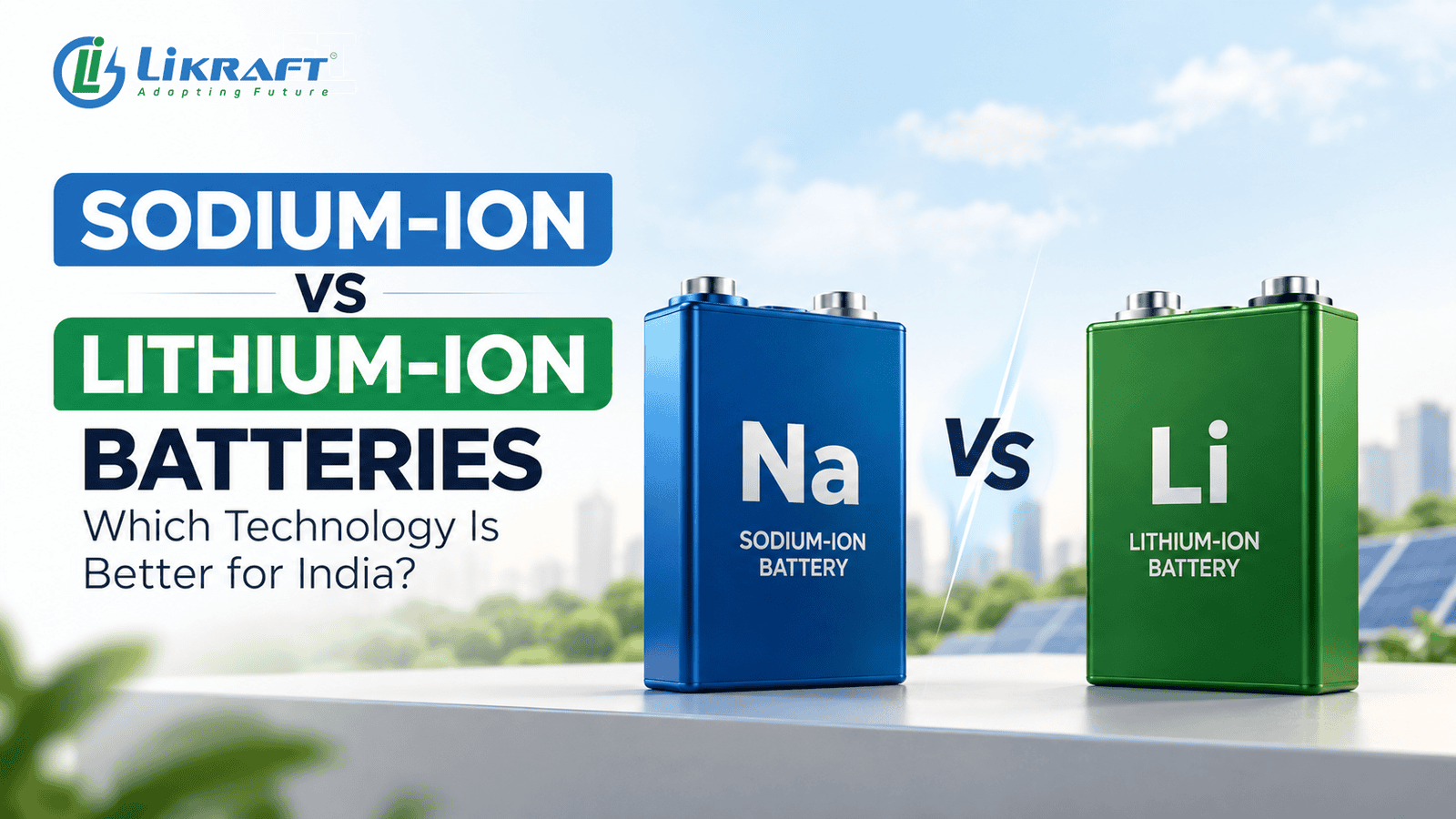
So, when we compare sodium-ion vs. lithium-ion batteries, which one makes more sense for India?
The answer depends on where the battery will be used.
What Is a Lithium-Ion Battery?
Lithium-ion batteries store energy by moving lithium ions between the positive and negative electrodes during charging and discharging.
There are several lithium-ion chemistry. LiFePO₄ (LFP) is one of the most widely used options for applications where cycle life, thermal stability, and dependable performance are important.
Today, lithium batteries are used in electric vehicles, solar systems, inverters, telecom equipment, industrial machines, and ESS.
One major advantage of lithium-ion technology is that the industry is already well established. Cell manufacturing, battery pack production, BMS technology, testing, and charging infrastructure have all developed around lithium-ion batteries.
What Is a Sodium-Ion Battery?
Sodium-ion batteries work on a principle similar to lithium-ion batteries. The main difference is the ion used to store and release energy.
Instead of lithium ions, sodium-ion batteries use sodium ions.
Sodium is widely available and is not dependent on the same lithium supply chain. This has made sodium-ion technology interesting for countries looking to diversify battery materials.
Another area where sodium-ion batteries have attracted attention is low-temperature operation. However, the technology is still developing, and its commercial manufacturing scale is much smaller than lithium-ion.
Sodium-ion vs. Lithium-ion Batteries: Main Differences
| Feature | Lithium-Ion | Sodium-Ion |
|---|---|---|
| Commercial maturity | Highly established | Emerging |
| Energy density | Generally higher | Generally lower |
| Supply chain | Mature | Developing |
| Low-temperature performance | Depends on chemistry | Potential advantage |
| EV adoption | Already widespread | Growing |
| ESS applications | Widely used | Emerging |
| Cell manufacturing scale | Very large | Smaller |
The energy-density difference is important.
If two batteries need to provide the same amount of energy, the battery with higher energy density can potentially be made smaller or lighter. This matters a lot in electric vehicles, especially when available space and vehicle weight are limited.
For stationary applications such as some solar and ESS installations, weight and size may be less important. This creates opportunities for alternative battery chemistry.
Is Sodium-Ion Better for India?
Not necessarily for every application.
Lithium-ion batteries currently have a major advantage in India because the technology is proven and already used across a wide range of products.
LiFePO₄: For example, LiFePO₄ batteries are widely used in electric three-wheelers, solar storage, telecom backup, and ESS. Manufacturers and service teams already have experience working with these systems.
Sodium-ion batteries could become useful in applications where energy density is less critical, and factors such as material availability, operating conditions, and overall system cost are important.
This could include selected electric two-wheeler, three-wheeler, stationary storage, and industrial applications.
Why Sodium-Ion Batteries Are Getting Attention in India
India imports a significant portion of the raw materials and components used in battery manufacturing. This makes supply-chain diversification an important issue for the country’s growing EV and energy-storage industries.
Sodium-ion technology offers another chemistry that manufacturers can develop alongside lithium-ion.
It does not mean lithium batteries are becoming obsolete.
Instead, the battery industry may move toward different chemistry for different jobs.
A compact electric car may have different battery requirements from a solar ESS. A telecom backup system may have different priorities from an electric rickshaw.
There is no reason every application needs to use exactly the same battery chemistry.
Lithium-ion vs. Sodium-ion for EVs
For EVs, battery weight and energy density are particularly important.
Lithium-ion batteries currently have an advantage because of their established energy density and large-scale production.
For electric scooters and other vehicles where range and weight are important, this remains a significant consideration.
Sodium-ion batteries may become more attractive for vehicles with shorter daily travel requirements or applications where lower energy density is acceptable.
The technology will need further commercial scaling before its position in India’s EV market becomes clearer.
Lithium-ion vs. Sodium-ion for Solar and ESS
Stationary energy storage is a different situation.
A battery installed in a building, telecom site, solar plant, or industrial facility does not need to carry its own weight while traveling.
That gives sodium-ion technology more room to compete.
LiFePO₄, however, a lithium-ion chemistry, particularly LiFePO₄, already has a strong position in solar and ESS because of its established performance, available products, BMS solutions, and manufacturing ecosystem.
For customers today, the choice should be based on the complete system rather than the chemistry name alone.
What Should Indian Battery Buyers Consider?
Before choosing between sodium-ion and lithium-ion, look at:
- Required energy capacity
- Available installation space
- Battery weight
- Charging requirements
- Operating temperature
- Expected cycle life
- Maximum charge and discharge current
- BMS and communication requirements
- Service support
- Total system cost
- Availability of replacement components
These factors can tell you much more about whether a battery is suitable than simply choosing the newest technology.
Likraft and the Future of Battery Technology
Likraft Batteries manufactures lithium battery packs for EVs, solar systems, inverter applications, telecom, industrial equipment, and energy storage systems.
LiFePO₄: Our approach is to match the battery design with the actual application. Depending on the requirement, battery packs can be configured with LiFePO₄ cells, Smart BMS, CAN, RS485, Bluetooth monitoring, and application-specific voltage and capacity.
As the Indian battery industry develops, technologies such as sodium-ion will create new possibilities. Lithium-ion will continue to play an important role at the same time.
The future is likely to be about choosing the right battery chemistry for the right application, rather than expecting one technology to work best everywhere.
Conclusion
The sodium-ion and Lithium-ion battery discussions are not about finding one universal winner.
Lithium-ion has the advantage of commercial maturity, higher energy density, and a well-developed ecosystem. Sodium-ion is an emerging technology with potential benefits in raw-material availability and selected operating conditions.
For India, both technologies could have a place in the growing EV and energy-storage market.
For buyers, the most important question is not simply, “Which battery is newer?”
The better question is:
“Which battery technology fits my application, operating conditions, and energy requirements?”
That is where proper battery design and the right manufacturing partner make a real difference.
Send us an email at info@likraft.com.
Address: Rai Industrial Area, Sonipat, Haryana