


Choosing the right lithium battery is not only about voltage. Battery capacity, measured in ampere-hours (Ah), also plays an important role in deciding how much energy the battery can store and how long it can run your equipment.
Two common options are 100Ah and 200Ah lithium batteries.
At first glance, the choice may seem simple: a 200Ah battery has twice the capacity of a 100Ah battery. But does that mean you always need a 200Ah battery?
Not necessarily.
The right choice depends on your load, backup requirement, available space, budget, charging setup, and application.
Let’s understand the difference between a 100 Ah vs. 200 Ah lithium battery and when each one makes sense.
What Does 100Ah or 200Ah Mean?
Ah stands for ampere-hour. It is a measure of the battery’s charge capacity.
A 100Ah battery has a rated capacity of 100 ampere-hours, while a 200Ah battery has approximately twice the charge capacity under comparable conditions.
However, Ah alone does not tell you the total energy stored in the battery.
To estimate energy, you also need to consider voltage:
Energy (Wh) = Voltage (V) × Capacity (Ah)
For example, a 51.2V battery:
51.2V × 100Ah = 5,120Wh = 5.12kWh
A 51.2V 200Ah battery:
51.2V × 200Ah = 10,240Wh = 10.24kWh
So, when the voltage is the same, a 200Ah battery provides roughly twice the nominal energy capacity of a 100Ah battery.
100 Ah vs. 200 Ah Lithium Battery: Quick Comparison
| Feature | 100Ah Lithium Battery | 200Ah Lithium Battery |
|---|---|---|
| Capacity | 100 Ah | 200 Ah |
| Energy at 51.2V | 5.12 kWh | 10.24 kWh |
| Backup potential | Lower | Higher |
| Physical size | Usually smaller | Usually larger |
| Weight | Generally lower | Generally higher |
| Cost | Lower | Higher |
| Suitable for | Smaller loads | Higher energy requirements |
| Installation space | Less | More |
The actual dimensions, weight, charging current, discharge capability, and cycle life depend on the battery design and manufacturer.
When Should You Choose a 100Ah Lithium Battery?
A 100Ah battery can be a practical choice when your energy requirement is moderate, and you do not need very long backup.
It can be suitable for applications such as:
- Home inverter backup
- Small solar systems
- Telecom backup
- Electric vehicles
- Small ESS applications
- Light industrial equipment
For example, a 51.2V 100Ah lithium battery provides approximately 5.12 kWh of nominal energy.
If your daily energy requirement is within that range, a 100Ah battery may provide a better balance between capacity, size, and cost.
It can also be easier to install in spaces with limited room.
When Should You Choose a 200Ah Lithium Battery?
A 200Ah battery makes more sense when you need greater energy storage or longer backup.
It can be considered for:
- Larger solar systems
- Higher-load inverter applications
- Commercial backup
- Larger ESS installations
- Industrial equipment
- Telecom applications with greater backup requirements
A 51.2V 200Ah battery has approximately 10.24 kWh of nominal energy, assuming the same nominal voltage.
That additional capacity can provide more available energy without necessarily increasing the battery system’s voltage.
Does 200Ah Mean Twice the Backup Time?
Not always.
If you compare two batteries with the same voltage and similar usable-energy conditions, a 200Ah battery can provide approximately twice the nominal energy of a 100Ah battery.
But actual backup time depends on the load.
For example, suppose a 51.2 V 100 Ah battery has approximately 5.12 kWh of nominal energy.
A 500W load would theoretically require:
5.12 kWh ÷ 0.5 kW = 10.24 hours
A 51.2 V 200 Ah battery has approximately 10.24 kWh of nominal energy:
10.24 kWh ÷ 0.5 kW = 20.48 hours
These are simplified calculations. Real backup time will be lower or different depending on usable battery capacity, inverter efficiency, load variation, temperature, BMS limits, and operating conditions.
100 Ah vs. 200 Ah for Solar Systems
For solar applications, battery capacity should be selected based on how much energy needs to be stored and how much backup is required.
A 100Ah battery may be sufficient for a smaller home or backup requirement.
A 200 Ah battery can be more appropriate when:
- The connected load is higher
- Longer backup is required
- More solar energy needs to be stored
- The system needs greater usable energy at night
It is also important to consider the solar panel capacity and inverter charging capability.
A larger battery is not automatically better if the solar system cannot charge it properly within the available charging window.
100 Ah vs. 200 Ah for an Inverter
The right capacity for an inverter depends on the connected load and the required backup time.
For example, if your essential load is relatively low and you only need short backup, a 100Ah battery may be sufficient.
If you have several appliances running together or need longer backup during power cuts, 200Ah may be a better option.
Before selecting the battery, calculate:
Load Power × Required Backup Time = Approximate Energy Requirement
Then account for inverter losses and the battery’s usable energy.
100 Ah vs. 200 Ah for ESS
Energy storage systems often require larger battery capacities because they may need to store solar energy, provide backup power, or support higher loads.
A 100Ah battery can work well for smaller ESS configurations.
A 200Ah battery may be preferred when the system requires more stored energy while maintaining the same voltage.
For larger installations, multiple battery modules can also be configured according to the system’s voltage, capacity, communication, and power requirements.
The BMS and inverter should support the intended battery configuration.
What About EV Applications?
For electric vehicles, choosing between 100Ah and 200Ah is more complicated than simply choosing the larger battery.
The battery must match:
- Motor power
- Controller requirements
- Vehicle weight
- Required driving range
- Available battery space
- Maximum discharge current
- Charging system
- Vehicle voltage
A higher-capacity battery can increase the available energy and potentially improve range, but it can also add weight, cost, and installation requirements.
For an EV manufacturer, the battery should therefore be designed around the complete vehicle rather than selected only by Ah rating.
Does 200Ah Have a Longer Battery Life?
Not automatically.
A 200Ah battery does not necessarily have twice the cycle life of a 100Ah battery.
Battery life depends on factors such as
- Cell chemistry
- Cell quality
- Depth of discharge
- Charging conditions
- Operating temperature
- Charge and discharge current
- BMS design
- Battery construction
However, if a larger battery is used for the same load, it may experience a lower relative discharge rate. This can be beneficial in some applications, depending on the battery’s design and operating conditions.
Can You Use Two 100Ah Batteries Instead of One 200Ah Battery?
In some systems, multiple batteries can be connected to increase overall capacity, but this should only be done when the battery manufacturer specifically supports the configuration.
The batteries may need to have:
- Compatible voltage
- Matching chemistry
- Compatible BMS
- Similar specifications
- Appropriate communication
- Proper protection
- Suitable installation and wiring
Do not simply connect batteries together because their voltage and Ah ratings appear to match.
Always follow the manufacturer’s parallel-connection guidelines.
How to Choose Between 100Ah and 200Ah
Ask yourself these questions before making a decision:
1. How much energy do you need?
Calculate your approximate daily or backup energy requirement.
2. What is your load?
A higher load generally requires greater battery capacity and appropriate discharge capability.
3. How much backup time do you want?
Longer backup generally means more usable battery energy is required.
4. How much space is available?
A 200Ah battery may require more physical space depending on its construction.
5. What is your budget?
Higher capacity generally means a higher initial investment.
6. Can your charger and inverter support the battery?
The complete system must be compatible with the selected battery.
Likraft 100Ah and 200Ah Lithium Battery Solutions
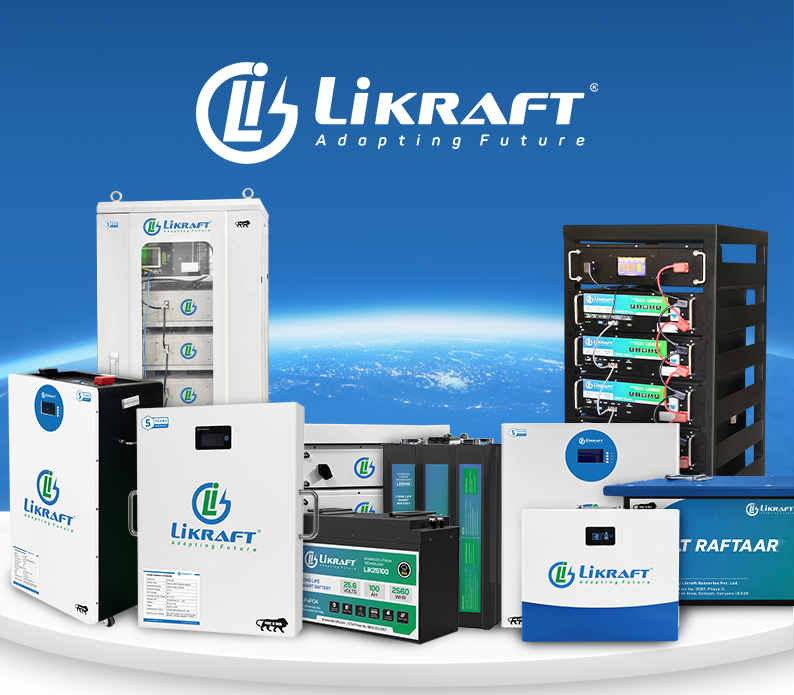
Likraft Batteries manufactures lithium battery solutions for EVs, solar systems, inverter backup, telecom, ESS, and industrial applications.
Depending on the application, battery packs can be configured according to required voltage, Ah capacity, dimensions, BMS, communication, and power requirements.
Likraft offers lithium battery configurations such as 51.2V 100Ah and can develop application-specific battery solutions where higher capacity is required.
Features can include:
- LiFePO₄ battery technology
- Smart BMS
- CAN communication
- RS485 communication
- Bluetooth monitoring
- Application-specific configurations
- Custom lithium battery pack solutions
For OEMs and businesses, the objective is not simply to select the biggest battery. It is to select a battery that matches the equipment and expected operating conditions.
Conclusion
When comparing a 100 Ah vs. 200 Ah lithium battery, the biggest difference is capacity.
At the same voltage, a 200Ah battery stores approximately twice the nominal energy of a 100Ah battery.
But that does not mean 200Ah is always the better choice.
A 100Ah battery may be more practical for smaller loads, limited space, and moderate backup requirements. A 200Ah battery can make more sense when longer backup or greater energy storage is required.
Before choosing, consider voltage, load, backup time, usable energy, charging capability, available space, budget, and application requirements.
The right battery is not the biggest one. It is the one that provides the required energy and power without being unnecessarily oversized.
Send us an email at info@likraft.com.
Address: Rai Industrial Area, Sonipat, Haryana