


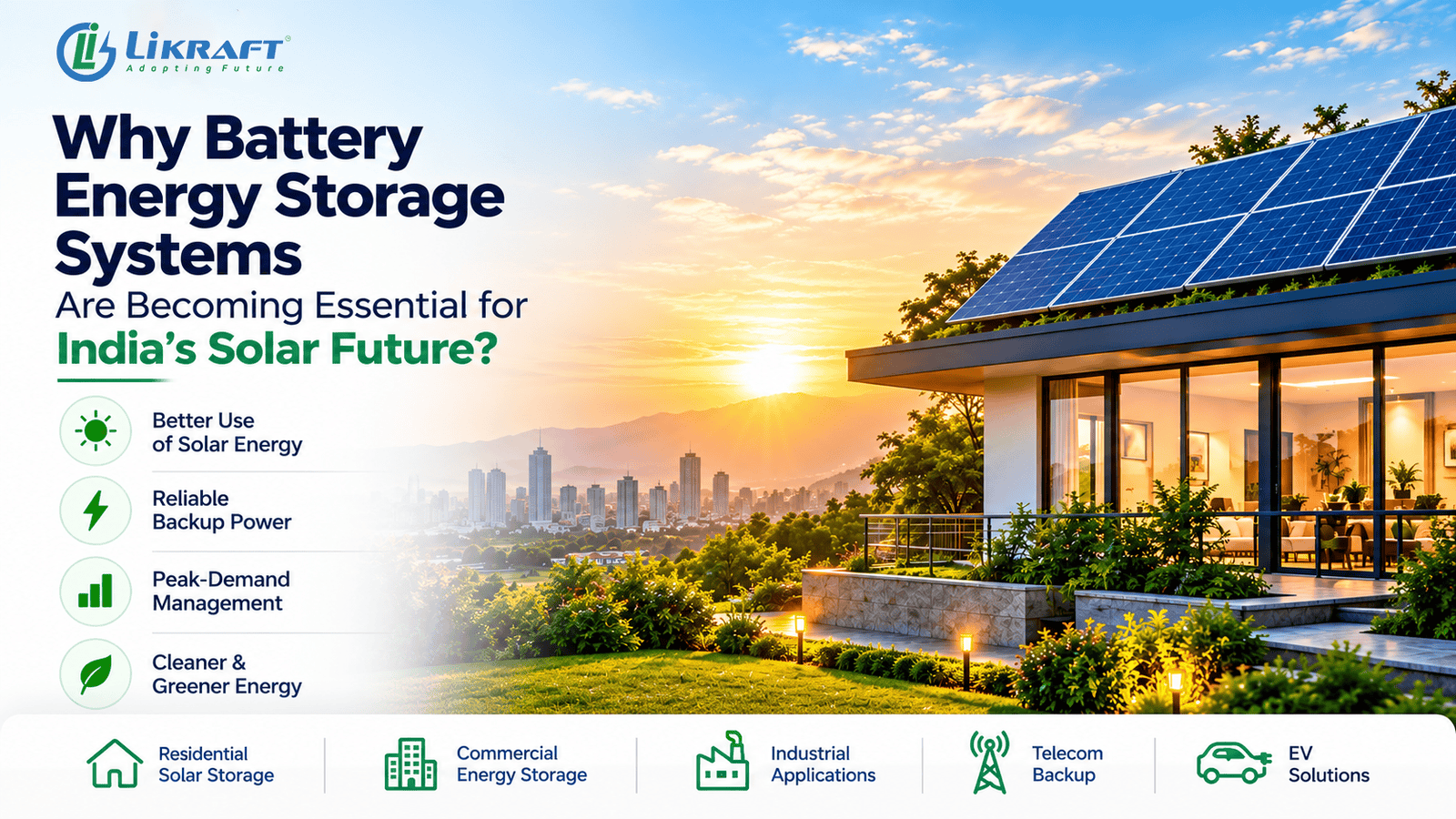
Solar power is becoming an important part of India’s energy mix. Homes, factories, commercial buildings, and businesses are installing solar panels to generate their own electricity. But solar power has one limitation: electricity is not generated at the same rate throughout the day, and generation stops after sunset.
This is where a Battery Energy Storage System (BESS) becomes useful.
A BESS stores electricity when it is available and supplies that energy when it is needed. With the growth of solar installations and renewable energy projects in India, battery storage is becoming an increasingly important part of modern power systems.
What Is a Battery Energy Storage System (BESS)?
A Battery Energy Storage System stores electrical energy in batteries for later use. It combines battery packs with monitoring, control, conversion, and protection equipment.
A typical BESS includes:
- Lithium battery packs
- Battery Management System (BMS)
- Power Conversion System (PCS) or inverter
- Energy Management System (EMS), depending on the design
- Electrical protection and monitoring equipment
Together, these components allow the system to store energy, monitor battery conditions, and supply electricity according to the application’s requirements.
Lithium batteries, particularly LiFePO4 batteries, are widely used in energy storage because of their cycle-life characteristics and suitability for repeated charging and discharging.
Why Is Battery Storage Growing in India?
India is expanding its renewable energy capacity, including solar and wind power. However, electricity demand does not always match the time when renewable energy is generated.
Battery storage helps address this difference.
According to Mercom India Research, India’s cumulative installed battery storage capacity reached 9.3 GWh by June 2026. This growth reflects the increasing role of storage in renewable energy integration, grid balancing, and peak-demand management.
For businesses, this development also creates opportunities for battery manufacturers, system integrators, solar companies, and energy-storage solution providers.
How Does a BESS Work With Solar Power?
A solar-plus-storage system can store surplus electricity generated during the day and make it available later.
The basic process is straightforward:
Solar Panels → Inverter/Charging System → Battery Storage → Electrical Loads
During periods of sufficient solar generation, the system can charge the battery. When solar generation decreases, or electricity is needed later, the stored energy can be used, depending on the system configuration.
This arrangement can help businesses use more of their own solar-generated electricity and reduce dependence on grid power during selected periods.
Actual savings depend on the electricity tariff, system size, energy consumption pattern, battery efficiency, and installation cost.
Key Benefits of Battery Energy Storage Systems
1. Better Use of Solar Energy
Without storage, surplus solar electricity may be exported to the grid or go unused, depending on the installation. A battery can store some of that energy for later use.
2. Backup Power
A properly configured BESS can supply backup power during an outage when designed with suitable inverter and backup functionality.
3. Peak-Demand Management
Commercial and industrial facilities may use stored energy during periods of high electricity demand. The financial benefit depends on the applicable tariff and operating schedule.
4. Improved Energy Management
Smart monitoring and control systems help users track energy flows, battery status, and charging and discharging activity.
5. Support for Renewable Energy Integration
At a larger scale, battery storage can help balance differences between renewable energy generation and electricity demand.
Why LiFePO₄ Batteries Are Used in Energy Storage
Lithium iron phosphate, commonly known as LiFePO₄ or LFP, is a lithium-ion battery chemistry widely used in stationary storage applications.
Its characteristics include:
- Good thermal stability
- Long cycle-life potential under suitable operating conditions
- High usable energy potential, depending on system design
- Suitability for repeated charge-discharge cycles
However, battery performance depends on cell quality, temperature, charging conditions, depth of discharge, BMS configuration, and overall system design.
Choosing a battery based only on its capacity or advertised cycle life may not provide a complete picture of its suitability.
How to Choose the Right BESS Battery
Before selecting a battery energy storage system, businesses should evaluate their actual energy requirements.
Important considerations include:
- Energy capacity (kWh): How much energy needs to be stored?
- Power rating (kW): How much power must the system supply at one time?
- Backup duration: How long should the system support the load?
- Battery chemistry: Which chemistry suits the application?
- Inverter compatibility: Can the inverter communicate and operate correctly with the battery?
- BMS and monitoring: What protection and communication features are required?
- Installation conditions: Is there adequate space, ventilation, and electrical protection?
- Service and warranty: What support is available after installation?
Energy capacity and power rating are different. A system may store substantial energy but still be unable to supply a particular load if its power rating is insufficient.
Likraft Lithium Battery Solutions for Energy Storage
Likraft Batteries manufactures lithium battery packs for applications including solar systems, inverter backup, telecom, industrial equipment, and energy storage systems.
Depending on the application, battery solutions can incorporate LiFePO₄ technology, smart LiFePO₄ BMS, CAN or RS485 communication, and application-specific voltage and capacity configurations.
For businesses planning an energy-storage project, the battery should be selected according to the required energy, power, backup duration, inverter compatibility, and operating environment.
A properly matched battery system can help support reliable operation and effective energy management. Battery energy storage systems
Conclusion
Battery Energy Storage Systems are becoming increasingly important as India expands its use of renewable energy. They help store electricity for later use, support backup requirements, and provide additional flexibility in how energy is managed.
For solar installations, commercial facilities, and industrial applications, the right BESS depends on more than battery capacity. Power rating, usable energy, BMS, inverter compatibility, safety, and operating requirements all matter.
As India’s energy-storage market develops, lithium battery technology will continue to play an important role in many applications.
The goal is simple: store energy when it is available and use it when it matters most.