


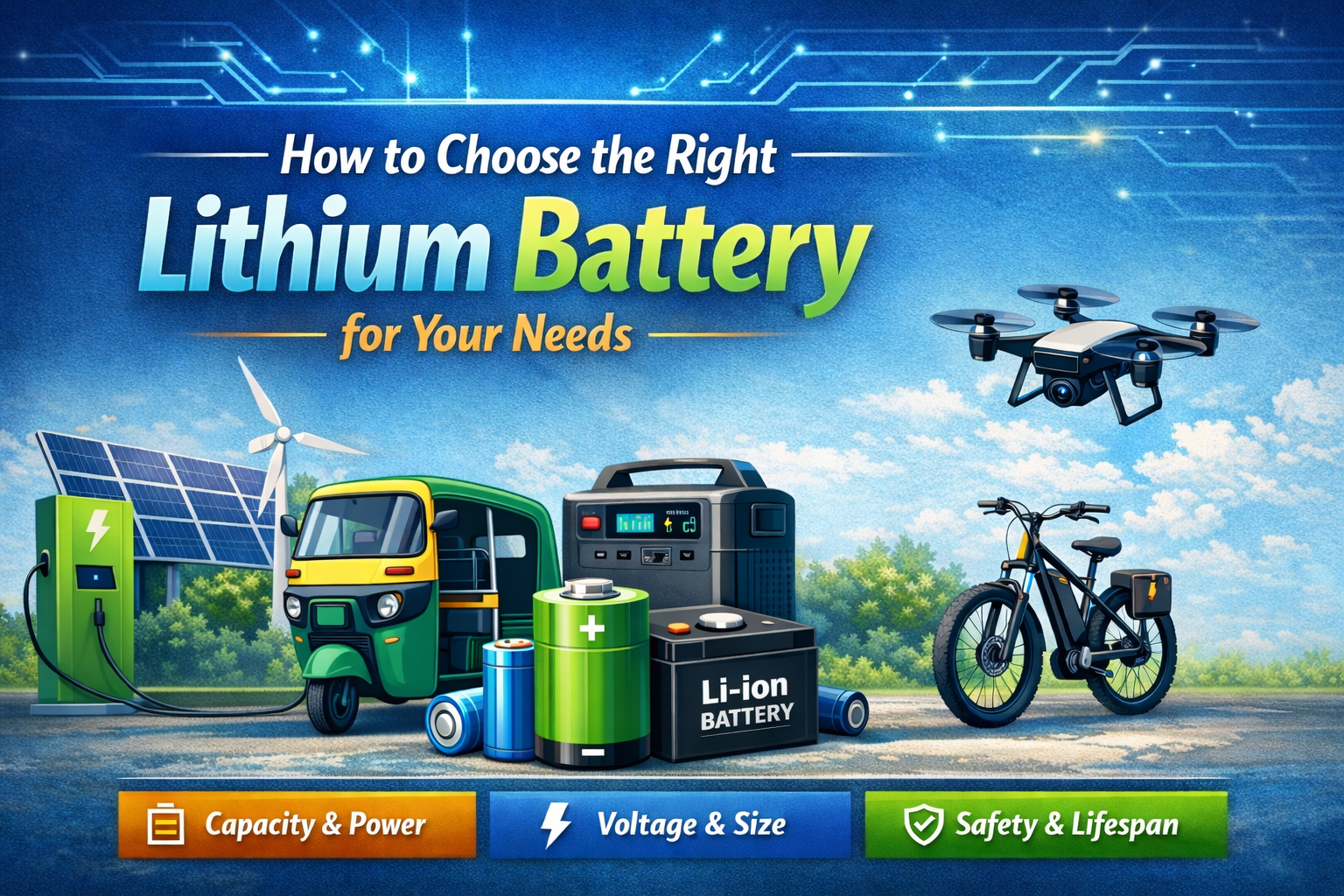
Choosing a lithium battery isn’t about picking the highest Ah or the lowest price.
It’s about matching the battery to the application.
Get that wrong, and you’ll face overheating, poor backup, short cycle life, or worse—system failure. Get it right, and you get long life, stable performance, and a real return on investment.
At Likraft Batteries, we’ve seen this firsthand across EV, solar, and industrial applications.
Let’s break it down the way it should be understood.
1. Start With the Application
This is the first filter. Always.
Different applications demand different battery characteristics:
- Home Inverter & Solar Storage
- Electric Vehicles (2W, 3W, E-Rickshaw)
- Energy Storage Systems (ESS)
- Telecom Backup
- Industrial Equipment
For example:
An e-rickshaw battery must handle high discharge currents daily. A solar ESS battery must support deep cycling. A telecom battery needs reliability and float performance.
Same lithium. Different engineering.
That’s why Likraft Batteries designs application-specific lithium battery solutions instead of a one-size-fits-all approach.
2. Understand Battery Chemistry
Not all lithium batteries are the same.
The most common types:
🔋 Lithium Iron Phosphate (LiFePO ₄)
- Long cycle life (3000–6000+ cycles)
- High thermal stability
- Safer chemistry
- Ideal for solar, inverter, EV, ESS
🔋 Lithium NMC (Nickel Manganese Cobalt)
- Higher energy density
- Compact and lightweight
- Used in performance EVs and portable systems
If safety, long life, and thermal stability matter, LiFePO₄ is usually the smarter choice—which is why most Likraft Batteries energy storage systems are built using advanced LiFePO₄ chemistry.
3. Capacity (Ah)—Don’t Guess It
Capacity determines backup time.
Formula to calculate required Ah:
Load (W) × Backup Hours ÷ Battery Voltage = Required Ah
Example:
1000W load × 3 hours ÷ 48V system ≈ 62.5 Ah
Always keep a buffer (20–25%). Running a battery constantly at 100% discharge reduces its lifespan.
Professional lithium battery manufacturers like Likraft Batteries calculate load profiles before recommending capacity because oversizing wastes money and undersizing kills performance.
4. Voltage Compatibility
This is non-negotiable.
Your battery must match:
- Inverter voltage (12V / 24V / 48V)
- Controller specifications
- Motor rating (in EV applications)
Mismatched voltage can damage:
- Inverters
- Motor controllers
- BMS systems
Always verify system voltage before purchase. A certified lithium battery supplier, such as Likraft Batteries, ensures proper system matching before dispatch.
5. Check the BMS Quality
Battery Management System (BMS) is the brain.
A good BMS protects against:
- Overcharge
- Overdischarge
- Short circuit
- Over-temperature
- Cell imbalance
Advanced BMS also offers:
- Bluetooth monitoring
- CAN communication
- Smart diagnostics
Cheap battery + weak BMS = future problems.
At Likraft Batteries, advanced multi-layer BMS protection is integrated to enhance battery safety, stability, and cycle life.
6. Cycle Life & Depth of Discharge (DoD)
Cycle life defines longevity.
Example:
- 6000 cycles at 80% DoD = ~15 years in solar use
- 2000 cycles at 100% DoD = shorter lifespan
High-quality lithium batteries operate best at 80–90% DoD.
If the manufacturer avoids sharing cycle data, that’s a red flag.
Reputable brands like Likraft Batteries publish tested cycle performance data for transparency.
7. Charging Speed & Efficiency
Lithium batteries charge faster than lead-acid.
But charging must match:
- Correct charger voltage
- Controlled current limits
- Compatible inverter settings
Charging efficiency:
- Lithium: ~95–98%
- Lead Acid: ~70–85%
Higher efficiency = lower electricity loss.
That’s one of the major reasons industries are shifting toward lithium battery solutions from Likraft Batteries.
8. Temperature Performance
India’s climate is not forgiving.
A good lithium battery should:
- Operate between -10°C to 60°C
- Have thermal protection
- Maintain performance in high heat
Thermal stability matters especially in EV and outdoor solar systems.
LiFePO₄ batteries used by Likraft Batteries offer superior thermal stability compared to conventional chemistries.
9. Certifications & Manufacturing Standards
Always check for:
- BIS certification
- IEC compliance
- UN38.3 (transport safety)
- ISO manufacturing standards
This isn’t paperwork. It’s protection.
Certified lithium battery manufacturers like Likraft Batteries follow strict quality control processes to ensure safety and compliance.
10. Warranty & Brand Credibility
Lithium is an investment.
Look for:
- 3 to 5-year warranty minimum
- Clear replacement terms
- Service network support
- Transparent technical documentation
A cheap battery today can become expensive tomorrow.
Established brands like Likraft Batteries provide structured warranty support and technical assistance for long-term reliability.
Final Checklist Before Buying
Ask yourself:
- What is my daily load requirement?
- What backup duration do I need?
- What voltage system am I using?
- How many cycles will I need per year?
- Does the battery have an advanced BMS?
- Is it certified and properly tested?
If you can answer these clearly, you won’t make the wrong choice.
Why the Right Lithium Battery Matters
The right battery means:
- Longer backup
- Faster charging
- Lower maintenance
- Better safety
- Higher ROI
The wrong battery means downtime.
And downtime costs money.
That’s why choosing a trusted manufacturer like Likraft Batteries makes a measurable difference.
Conclusion
Choosing the right lithium battery isn’t complicated—but it must be technical.
- Match chemistry to application.
- Match capacity to load.
- Match the voltage to the system.
- Never compromise on safety and BMS quality.
When engineered correctly, lithium batteries from Likraft Batteries can last over a decade with consistent performance.
That’s not marketing.
That’s chemistry, engineering precision, and disciplined manufacturing. 🔋
Send us an email at info@likraft.com
Address: Rai Industrial Area, Sonipat, Haryana
Just downloaded 777sxgameapk and it’s a fun little time-waster. Not groundbreaking, but decent for kicking back for a few minutes. Give it a download if you’re bored 777sxgameapk.