


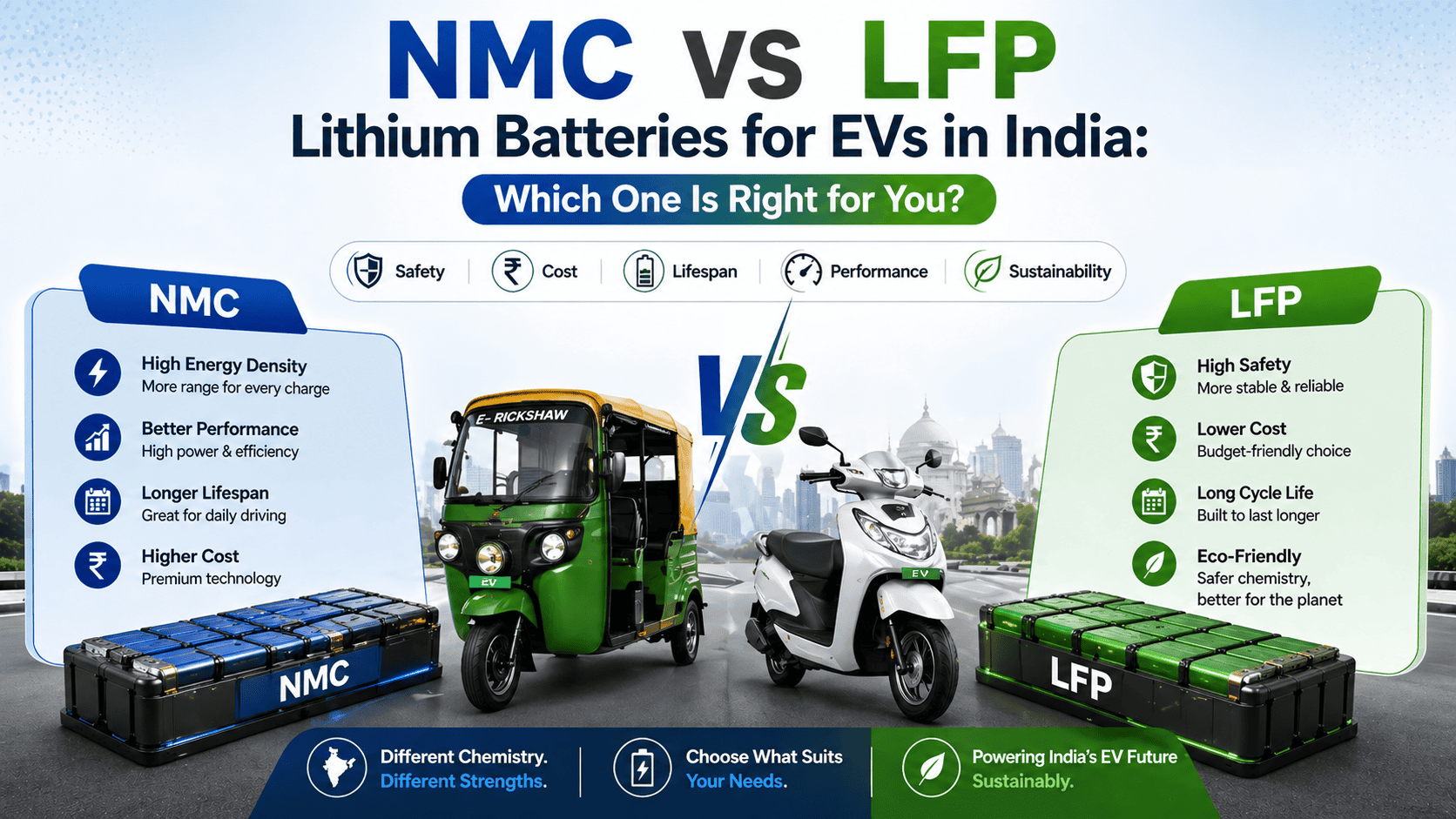
Electric vehicles are rapidly transforming how India moves — from last-mile delivery e-rickshaws in Delhi to high-speed electric scooters in Bengaluru. But at the heart of every EV sits one critical component that determines its range, safety, lifespan, and total cost: the lithium-ion battery pack.
If you’re an EV manufacturer, fleet operator, or OEM evaluating battery solutions, you’ve almost certainly come across two chemistry options—NMC (Lithium Nickel Manganese Cobalt Oxide) and LFP (Lithium Iron Phosphate). Both are lithium-ion technologies, but they perform very differently in real-world Indian conditions.
This guide breaks down exactly what makes each chemistry unique, how they compare head-to-head, and which one is the smarter choice depending on your application.
What Is NMC (Nickel Manganese Cobalt)?
NMC batteries use a cathode made of nickel, manganese, and cobalt in varying ratios — commonly 6:2:2 or 8:1:1. This combination delivers a high energy density, meaning more usable energy can be packed into a smaller, lighter cell.
Why NMC is popular for EVs:
- High energy density (150–220 Wh/kg) means longer range per kg of battery weight
- Better power output for acceleration-heavy applications
- Lighter weight, which is important for two-wheelers and performance scooters
Limitations to be aware of:
- Less thermally stable than LFP—requires a more sophisticated BMS (Battery Management System)
- Cobalt content makes it more expensive and subject to global supply chain volatility
- Cycle life is lower — typically 500–1,000 charge cycles before significant capacity loss
NMC is currently the dominant chemistry in premium electric two-wheelers and four-wheelers globally, including models by Ola Electric, Ather Energy, and most major international EV brands.
What Is LFP (Lithium Iron Phosphate)?
LFP batteries use iron and phosphate as the cathode material—both are widely available and far less expensive than cobalt. This chemistry was traditionally seen as “lower performance,” but advances in cell design have made modern LFP batteries highly competitive.
Why LFP is gaining traction in India:
- Exceptional thermal stability—LFP cells do not undergo thermal runaway as easily, making them inherently safer
- Very long cycle life — 2,000 to 4,000+ cycles, meaning the battery can last 8–12 years with regular use
- Lower cost per kWh, especially as Chinese LFP cell manufacturing scales up
- Performs well in high-temperature environments like Indian summers
Limitations:
- Lower energy density (90–160 Wh/kg) means heavier packs for the same range
- The voltage plateau is very flat, which makes State of Charge (SoC) estimation less accurate without a quality BMS
- Slightly lower peak power output compared to NMC
LFP has become the chemistry of choice for Tesla’s standard-range vehicles, BYD’s entire passenger car lineup, and increasingly for Indian e-rickshaws, L3 three-wheelers, solar storage, and telecom backup applications.
NMC vs LFP: Head-to-Head Comparison
| Parameter | NMC | LFP |
|---|---|---|
| Energy density | 150–220 Wh/kg | 90–160 Wh/kg |
| Cycle life | 500–1,000 cycles | 2,000–4,000+ cycles |
| Thermal stability | Moderate | Excellent |
| Cost (per kWh) | Higher | Lower |
| Operating temp. range | -20°C to 55°C | -20°C to 60°C |
| Cobalt content | Yes | No |
| Best for | Performance EVs, 2-wheelers | 3-wheelers, commercial fleets, solar, telecom |
| Risk of thermal runaway | Moderate | Very low |
| Typical warranty | 2–3 years | 3–5 years |
How Indian Operating Conditions Affect the Choice
India presents a unique set of challenges that don’t exist in many Western markets where these battery chemistries were first developed. Understanding these conditions is essential to making the right call.
1. Extreme Summer Heat
In states like Rajasthan, Gujarat, and Delhi-NCR, ambient temperatures regularly exceed 45°C in summer. This is brutal for any lithium cell, but NMC cells are more sensitive to heat-induced degradation. LFP’s superior thermal stability means it retains capacity better and is less prone to safety incidents in these conditions.
At Likraft, our LFP packs undergo high-temperature cycle testing specifically designed for Indian summer conditions before leaving our Sonipat facility.
2. Frequent Stop-and-Go Charging
Indian EV users—especially e-rickshaw and delivery fleet operators—often opportunity-charge throughout the day rather than completing full charge cycles. LFP chemistry handles partial State of Charge (SoC) cycling far better than NMC, which can degrade faster under irregular charging patterns.
3. Total Cost of Ownership (TCO)
While NMC packs may have a lower upfront cost in some configurations, LFP’s longer cycle life dramatically reduces the total cost of ownership over 5–10 years. For fleet operators running 100+ vehicles, this difference translates to lakhs of rupees saved in battery replacement costs.
4. Load and Terrain
India’s three-wheelers and L5 loader vehicles carry heavy loads over roads that can be rough, with frequent vibrations. LFP’s more stable chemistry and robust cell structure handle mechanical stress better over long operational periods.
Which Chemistry Should You Choose?
The answer depends entirely on your application. Here’s a practical guide:
Choose NMC if you are building or buying:
- A high-speed electric scooter (top speed 60+ km/h) where range per kg matters
- A premium electric two-wheeler where weight and performance are the primary selling points
- An application where the charging infrastructure is reliable, and temperature-controlled storage is possible
Choose LFP if you are building or buying:
- An electric 3-wheeler (L3/L5) for passenger or cargo use
- An e-rickshaw or e-loader that charges daily from grid power
- A commercial delivery fleet where 5+ years of reliable operation without battery replacement is a priority
- Any application in hot Indian climates where thermal safety is a concern
- Solar storage or inverter backup systems
At Likraft, we manufacture both NMC and LFP battery packs across our mobility range—because we believe the right chemistry depends on the right application, not a one-size-fits-all approach.
What About the BMS? (Often Overlooked)
Whichever chemistry you choose, the Battery Management System (BMS) is what keeps it safe and performing optimally. A poor BMS on a good LFP pack will underperform and degrade faster than a high-quality BMS on an average NMC pack.
A quality BMS should provide:
- Overcharge and over-discharge protection
- Cell balancing (passive or active)
- Temperature monitoring and cutoff
- Short circuit protection
- State of Charge and State of Health reporting
Every Likraft battery pack—whether NMC or LFP—ships with an integrated BMS engineered for Indian grid conditions and usage patterns.
The Road Ahead: Will LFP Dominate Indian EVs?
Global trends strongly suggest LFP is gaining ground. Tesla switched its standard-range Model 3 and Model Y to LFP globally. BYD—now India’s second-largest EV player—runs its entire Blade Battery lineup on LFP. In India, where commercial EV applications (3-wheelers, delivery fleets, and e-buses) are growing faster than consumer EVs, LFP’s economics and longevity make it a natural fit.
That said, NMC will continue to be relevant for premium two-wheelers and four-wheelers where range and performance are the primary value drivers.
The real winner for Indian EV manufacturers will be those who choose the right chemistry for the right application and pair it with a high-quality BMS and rigorous cell testing.
Summary
- NMC = higher energy density, better for performance two-wheelers, costlier, shorter cycle life
- LFP = safer, longer cycle life, lower TCO, better for commercial and high-temperature Indian applications
- The BMS matters as much as the chemistry—don’t overlook it
- For Indian commercial EV applications, LFP is increasingly the smarter long-term investment
Need a Custom Battery Pack for Your EV?
Likraft manufactures both NMC and LFP lithium-ion battery packs at our Sonipat, Haryana facility—with a capacity of 15,000+ packs per month. We work with EV OEMs, fleet operators, and system integrators across India to design and supply custom battery solutions tailored to your voltage, capacity, and application requirements.
Send us an email at info@likraft.com
Address: Rai Industrial Area, Sonipat, Haryana