


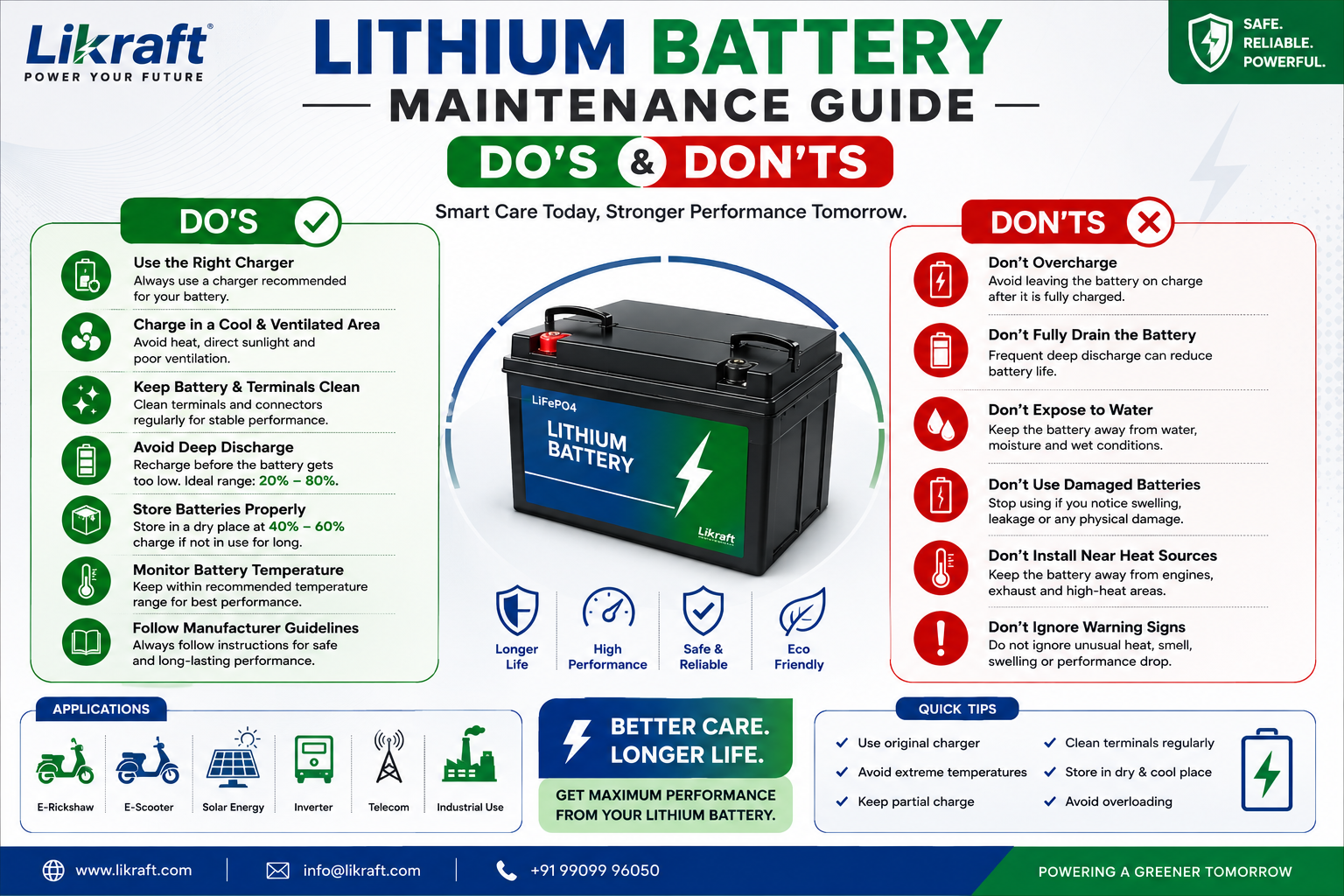
Lithium batteries are becoming the preferred power solution across electric vehicles, solar systems, telecom backup, inverters, and energy storage applications. Their longer life, faster charging, and higher efficiency make them a smart choice for modern energy needs.
But battery performance does not depend only on technology. Proper maintenance also plays a major role in keeping a lithium battery safe, reliable, and long-lasting.
At Likraft Batteries Pvt. Ltd., we believe that the right battery habits can help users get better performance and improved battery life over time. Here’s a simple guide covering the most important do’s and don’ts for lithium battery maintenance.
Why Lithium Battery Maintenance Is Important
Regular battery care helps:
- Improve battery lifespan
- Maintain stable performance
- Reduce charging issues
- Support safe operation
- Minimise unexpected breakdowns
- Lower replacement and service costs
Whether the battery is used in an EV, solar setup, telecom application, or inverter system, maintenance directly affects overall efficiency.
Do’s of Lithium Battery Maintenance
Use the Correct Charger
Always charge the battery with a charger recommended for the specific battery voltage and chemistry.
Using an incompatible charger may lead to:
- Improper charging
- Excess heat generation
- Reduced battery life
- Damage to battery cells or BMS
Charge the Battery in a Cool and Ventilated Area
Lithium batteries perform best when charged in a clean and ventilated environment.
Avoid charging in:
- Direct sunlight
- Extremely hot locations
- Areas with poor airflow
Maintaining proper temperature conditions supports healthy battery performance.
Keep Battery Terminals Clean
Dust and loose connections can affect battery efficiency.
Regularly inspect:
- Battery terminals
- Connectors
- Wiring connections
Clean terminals help maintain proper current flow and stable operation.
Avoid Deep Discharge
Do not wait until the battery is empty before charging.
Frequent deep discharge can:
- Increase stress on battery cells
- Reduce cycle life
- Affect long-term performance
For better battery health, recharge the battery before it reaches extremely low charge levels.
Store Batteries Properly
If the battery will remain unused for a long period:
- Store it in a dry place
- Keep it away from moisture
- Maintain partial charge during storage
Proper storage helps preserve battery condition and performance.
Monitor Battery Temperature
Very high temperatures can reduce battery efficiency and lifespan.
Very low temperatures may temporarily affect charging and backup performance.
Maintaining recommended operating temperatures helps improve battery reliability.
Follow Manufacturer Recommendations
Every lithium battery system is designed with specific operating guidelines.
Always follow:
- Charging instructions
- Installation recommendations
- Voltage limits
- Safety guidelines
This helps ensure safe and efficient battery operation.
Don’ts of Lithium Battery Maintenance
Don’t Overcharge the Battery
Continuous overcharging may affect battery performance over time, even when protection systems are installed.
Disconnect the charger once charging is completed whenever possible.
Don’t Expose Batteries to Water
Lithium batteries should always be protected from:
- Rainwater
- Moisture
- Wet surfaces
- Water leakage
Water exposure can damage internal battery components.
Don’t Use Damaged Batteries
Stop using the battery immediately if you notice:
- Swelling
- Leakage
- Unusual heating
- Physical damage
- Burning smell
Damaged batteries should only be inspected by trained professionals.
Don’t Install Batteries Near Heat Sources
Avoid placing batteries close to:
- Engines
- Exhaust systems
- Industrial machinery
- Direct sunlight for long durations
Excess heat can affect battery life and safety.
Don’t Ignore Performance Changes
Reduced backup time, charging irregularities, or sudden voltage drops may indicate battery issues.
Early inspection can help prevent larger problems later.
Simple Tips to Improve Lithium Battery Life
| Maintenance Tip | Benefit |
|---|---|
| Use recommended charger | Safe charging performance |
| Avoid extreme temperatures | Better battery lifespan |
| Keep terminals clean | Stable power delivery |
| Prevent deep discharge | Improved cycle life |
| Store correctly | Reduced battery degradation |
| Follow operating guidelines | Reliable long-term performance |
Lithium Battery Care for EV Applications
Lithium batteries are used in:
- E-rickshaws
- Electric scooters
- Electric bikes
- Golf carts
- EV fleets
require regular charging and continuous usage. Proper maintenance becomes even more important in these applications.
For better EV battery performance:
- Charge regularly
- Avoid unnecessary overloading
- Park vehicles in shaded areas
- Use compatible charging systems
- Inspect wiring and connectors periodically
Conclusion
Lithium batteries are designed for dependable and efficient energy storage, but proper maintenance is essential for achieving long-term performance.
Following basic maintenance practices can help improve:
- Battery lifespan
- Charging efficiency
- Safety
- Overall reliability
With the right care, lithium batteries can continue delivering strong and consistent performance across EV, solar, telecom, and industrial applications.
Send us an email at info@likraft.com
Address: Rai Industrial Area, Sonipat, Haryana