


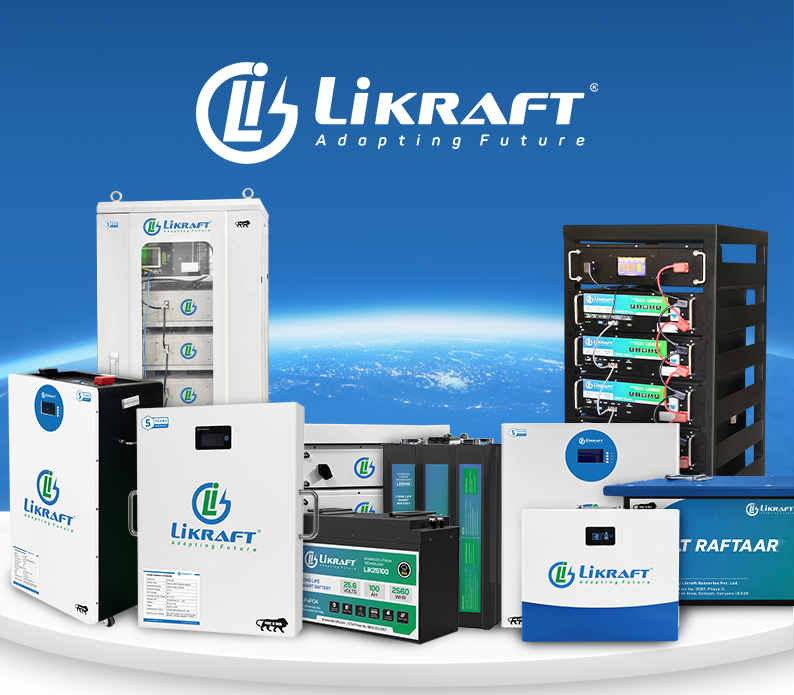
When buying a lithium battery for an electric scooter, e-rickshaw, home inverter, solar system, or Energy Storage System (ESS), you’ll often come across terms like 48V 30Ah, 51.2V 100Ah, or 60V 100Ah.
But what do Voltage (V) and Ampere-hour (Ah) actually mean? More importantly, how do you know which battery is right for your application?
At Likraft Batteries Pvt. Ltd., we help customers choose the right lithium battery by explaining technical specifications simply and practically.
What Is Voltage (V)?
Voltage (V) represents the electrical pressure that pushes power from the battery to your vehicle or equipment.
Think of voltage as the power level your system requires to operate correctly.
Common lithium battery voltages include:
- 24V Lithium Battery
- 36V Lithium Battery
- 48V Lithium Battery
- 51.2V LiFePO4 Battery
- 60V Lithium Battery
- 72V Lithium Battery
- 96V Lithium Battery
The correct voltage depends entirely on your equipment or vehicle.
Important: Always use the voltage recommended by the manufacturer. Installing the wrong voltage battery can affect performance or even damage the system.
What Is Ampere-Hour (Ah)?
Ampere-hour (Ah) indicates the battery’s energy storage capacity.
Simply put:
- Higher Ah = More stored energy
- Higher Ah = Longer backup or driving range
Examples:
- 30Ah Battery
- 50Ah Battery
- 100Ah Battery
- 105Ah Battery
- 200Ah Battery
- 314Ah Battery
If two batteries have the same voltage but different Ah ratings, the higher Ah battery will generally provide longer operating time.
Understanding Voltage vs Ah
Many people confuse voltage and Ah, but they serve different purposes.
| Voltage (V) | Ampere-hour (Ah) |
|---|---|
| Determines system compatibility | Determines battery capacity |
| Powers the equipment | Decides backup time or driving range |
| Must match the device requirement | Can vary depending on usage |
| Cannot be changed | Can be selected based on requirement |
Think of it this way:
- Voltage = Power Requirement
- Ah = Battery Capacity
Both are equally important when selecting a battery.
How to Identify the Voltage and Ah of Your Battery
The easiest way is to check the battery label or specification plate.
You’ll usually see markings such as:
- 48V 30Ah
- 51.2V 100Ah
- 60V 100Ah
- 72V 50Ah
For example:
48V 30Ah
- Voltage = 48V
- Capacity = 30Ah
51.2V 100Ah
- Voltage = 51.2V
- Capacity = 100Ah
These specifications tell you both the operating voltage and the battery capacity.
How to Choose the Right Voltage
Choosing the correct voltage depends on your application.
Electric Scooters
Most electric scooters use:
- 48V
- 60V
- 72V
Always check your vehicle manufacturer’s recommendation.
E-Rickshaws
Most lithium e-rickshaw batteries commonly use:
- 48V
- 51.2V
- 60V
The required voltage depends on the motor and controller configuration.
Home Inverter
Lithium inverter systems commonly operate on:
- 12V
- 24V
- 48V
Choose the voltage supported by your inverter.
Solar Energy Storage System
Solar applications generally use:
- 24V
- 48V
- 51.2V
Larger commercial systems may require higher-voltage battery banks.
How to Choose the Right Ah Rating
The Ah rating depends on how long you want the battery to operate.
For example:
Home Backup
If you need longer backup during power cuts, choose a higher Ah battery.
Electric Scooter
A higher Ah battery generally allows for a longer driving range between charges.
E-Rickshaw
Commercial vehicles benefit from higher Ah batteries because they operate for longer hours.
Solar System
Higher-capacity batteries store more solar energy, providing longer backup during evenings or cloudy weather.
Can You Increase Ah Without Changing Voltage?
Yes.
If your system supports it, you can choose a battery with a higher Ah rating while keeping the same voltage.
Example:
Instead of:
48V 30Ah
You may choose:
48V 50Ah
The voltage remains the same, but the battery stores more energy, increasing backup time or driving range.
Always confirm compatibility with your equipment before upgrading.
Why Choosing the Right Battery Matters
Using the correct voltage and capacity helps:
- Improve battery life
- Increase efficiency
- Ensure safe operation
- Deliver consistent performance
- Maximise backup time
- Reduce maintenance
Selecting the wrong battery can lead to reduced performance or compatibility issues.
Why Choose Likraft Lithium Batteries?
At Likraft, we manufacture advanced lithium battery solutions for:
- Electric Scooters
- Electric Motorcycles
- E-Rickshaws
- Home Inverters
- Solar Systems
- Energy Storage Systems (ESS)
- Telecom Backup
- Industrial Applications
Every battery is designed using premium LiFePO4 cells, an intelligent Battery Management System (BMS), and high-quality components to deliver reliable, safe, and efficient performance.
Conclusion
Understanding Voltage (V) and Ampere-hour (Ah) makes it much easier to choose the right lithium battery.
Voltage determines compatibility, while Ah determines how long the battery can deliver power.
Whether you’re buying a battery for an electric scooter, e-rickshaw, home inverter, solar system, or ESS, selecting the right combination of voltage and capacity ensures safe, reliable, and long-lasting performance.
At Likraft Batteries, we’re committed to helping customers choose the right lithium battery for every application with quality products backed by advanced technology.
Send us an email at info@likraft.com
Address: Rai Industrial Area, Sonipat, Haryana