


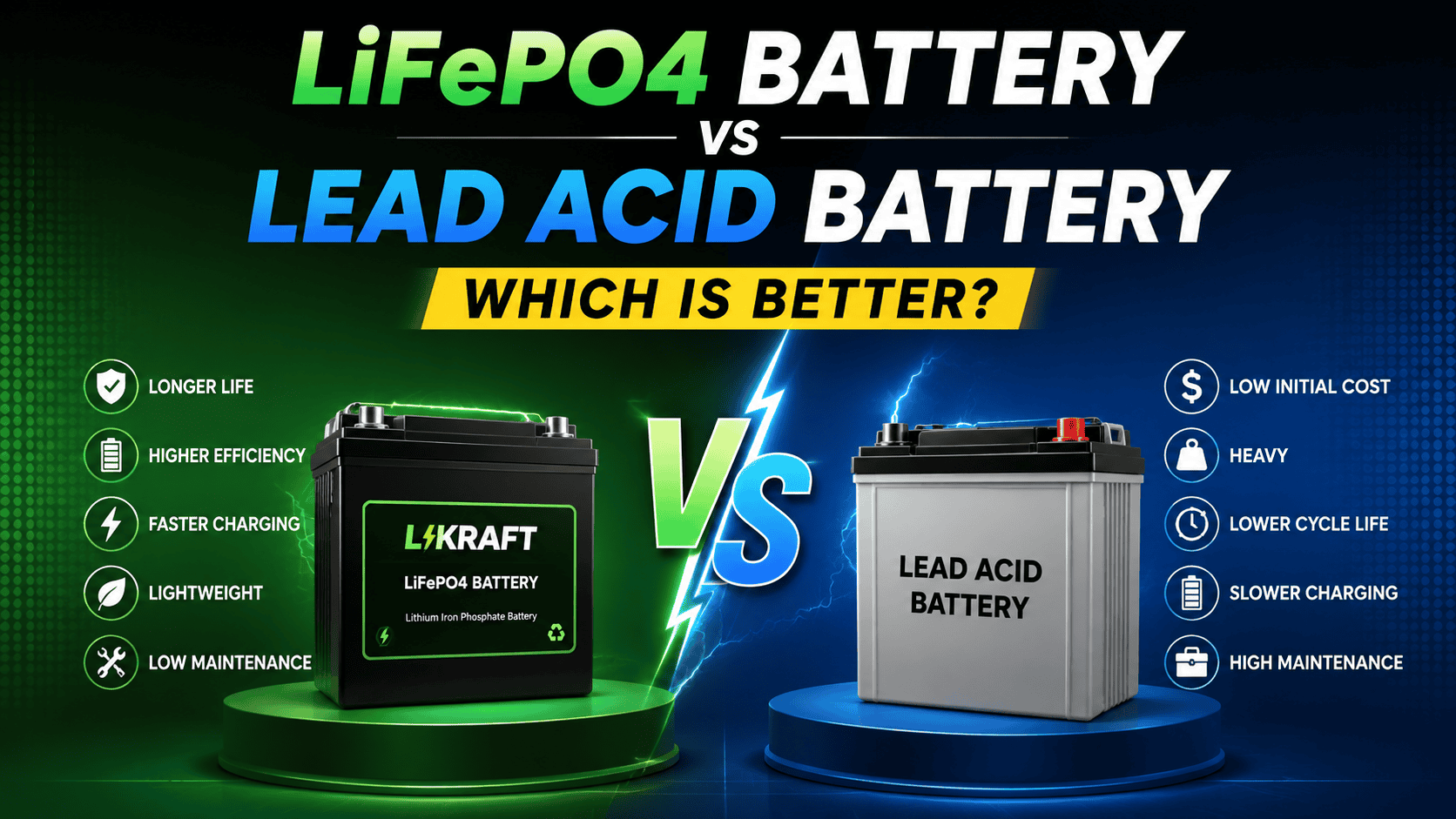
Choosing the right battery is an important decision for electric vehicles, home inverters, solar systems, telecom backup, and energy storage applications. For many years, lead-acid batteries have been the traditional choice. Today, LiFePO₄ batteries are becoming increasingly popular because of their longer life, lower maintenance, faster charging, and better usable energy.
But which battery is actually better for your application?
At Likraft Batteries Pvt. Ltd., we manufacture lithium battery solutions using advanced technology and premium-quality components for EV, solar, inverter, ESS, telecom, and industrial applications. In this guide, we’ll compare LiFePO₄ batteries vs lead-acid batteries and explain where each technology makes sense.
What Is a LiFePO₄ Battery?
LiFePO₄ stands for Lithium Iron Phosphate. It is a lithium-ion battery chemistry known for its combination of safety, cycle life, thermal stability, and performance.
LiFePO₄ batteries are widely used in:
- Electric scooters
- E-rickshaws
- Electric vehicles
- Solar energy storage
- Home inverter systems
- Energy Storage Systems (ESS)
- Telecom backup
- Industrial applications
A LiFePO₄ battery also normally includes a Battery Management System (BMS) that monitors and protects the battery during charging and discharging.
What Is a Lead-Acid Battery?
Lead-acid batteries are one of the oldest rechargeable battery technologies and have been widely used for automotive, inverter, UPS, and backup applications.
Common types include:
- Flooded lead-acid batteries
- Tubular batteries
- AGM batteries
- Gel batteries
Lead-acid batteries remain popular because they are widely available and generally have a lower initial purchase price.
However, they are heavier, require more maintenance in many applications, and generally have a shorter cycle life than quality LiFePO₄ batteries.
LiFePO₄ vs Lead Acid: Key Differences
| Feature | LiFePO₄ Battery | Lead-Acid Battery |
|---|---|---|
| Cycle Life | High | Lower |
| Weight | Lightweight | Heavy |
| Charging Speed | Faster | Slower |
| Maintenance | Very Low | Higher |
| Usable Capacity | Higher | Lower |
| Energy Efficiency | High | Moderate |
| Voltage Stability | Better | Drops more during discharge |
| Safety | High with proper BMS | Established technology |
| Installation Space | More compact | Larger |
| Long-Term Value | High | Depends on application |
The exact performance depends on battery design, operating conditions, charging method, temperature, and manufacturer quality.
1. LiFePO₄ Battery Offers Longer Cycle Life
One of the biggest advantages of LiFePO₄ technology is its cycle life.
A battery cycle refers to a complete equivalent charge and discharge cycle. Quality LiFePO₄ batteries can provide thousands of cycles when operated within the manufacturer’s recommended conditions.
Lead-acid batteries generally provide fewer cycles, particularly when they are frequently deeply discharged.
For applications such as EVs, solar storage, and daily backup, longer cycle life can significantly reduce the frequency of battery replacement.
2. LiFePO₄ Batteries Are Much Lighter
Battery weight matters, especially in electric mobility.
A lead-acid battery stores energy in a relatively heavy package. LiFePO₄ technology can provide similar usable energy with considerably less weight.
This is particularly useful for:
- Electric scooters
- Electric bikes
- E-rickshaws
- Golf carts
- Portable energy systems
Reducing battery weight can also help improve vehicle efficiency and handling.
3. Faster Charging
Charging time is another major difference.
LiFePO₄ batteries can generally accept higher charging currents than traditional lead-acid batteries, depending on the battery design and charger specification.
This can be particularly valuable for commercial EVs where the vehicle needs to return to operation quickly.
However, charging speed should always remain within the battery manufacturer’s recommended limits.
4. Higher Usable Energy
Battery capacity is often expressed in Ah, but Ah alone doesn’t tell the whole story.
The amount of energy you can actually use depends on the battery’s voltage, capacity, discharge limits, efficiency, and recommended depth of discharge.
LiFePO₄ batteries generally allow a higher usable portion of their rated capacity than lead-acid batteries.
This can provide longer practical backup from a battery with a similar nominal capacity.
5. Lower Maintenance
Traditional flooded lead-acid batteries can require regular maintenance, including checking electrolyte levels and topping up water.
LiFePO₄ batteries are generally maintenance-free under normal operating conditions.
There is no routine electrolyte top-up requirement, making them convenient for:
- Homes
- Offices
- Solar installations
- EVs
- Commercial backup systems
6. Better Performance During Discharge
Lead-acid battery voltage tends to decline significantly as the battery discharges.
LiFePO₄ batteries generally maintain a more stable voltage throughout much of their discharge range.
This means equipment can receive more consistent power during operation.
For applications where stable voltage is important, this can be a significant advantage.
7. Safety and Battery Management
LiFePO₄ is widely regarded as one of the more thermally stable lithium-ion chemistries.
However, battery safety depends on the complete battery design, not just the cell chemistry.
A properly designed LiFePO₄ battery should include appropriate:
- BMS protection
- Cell matching
- Charging controls
- Thermal management
- Electrical protection
- Mechanical protection
At Likraft, the BMS is an important part of our lithium battery architecture. It helps monitor voltage, current, temperature, and other operating conditions to protect the battery system.
LiFePO₄ vs Lead-Acid for Electric Scooters
For electric scooters, battery weight, charging time, cycle life, and usable energy are important considerations.
A LiFePO₄ battery can offer:
- Lower battery weight
- Longer cycle life
- Faster charging
- Lower maintenance
- Consistent power delivery
For daily commuting and commercial EV usage, these advantages can make lithium technology a practical long-term choice.
LiFePO₄ vs Lead-Acid for E-Rickshaws
E-rickshaws can operate for several hours every day, which means the battery may experience frequent charging and discharging.
A LiFePO₄ e-rickshaw battery can help provide:
- Longer operational life
- Reduced charging downtime
- Lower maintenance
- Consistent performance
- Better energy efficiency
For high-usage commercial vehicles, the higher initial investment in lithium technology may be offset by longer service life and reduced maintenance.
LiFePO₄ vs Lead-Acid for Home Inverters
For home inverter applications, backup time, charging speed, space, and maintenance are important.
LiFePO₄ inverter batteries offer:
- Faster recharge
- Compact installation
- Longer service life
- Maintenance-free operation
- Better usable capacity
This makes lithium inverter batteries an attractive alternative to conventional lead-acid batteries for modern homes.
LiFePO₄ vs Lead-Acid for Solar Energy Storage
Solar systems generate electricity during the day, but that energy may need to be stored for use at night or during power outages.
LiFePO₄ batteries are well suited to solar storage because they can handle frequent charge-discharge cycles.
Benefits include:
- High cycle life
- Good charging efficiency
- High usable capacity
- Low maintenance
- Stable performance
For residential and commercial solar systems, LiFePO₄ can be a strong long-term storage option.
What About Initial Cost?
This is where lead-acid batteries can appear attractive.
A lead-acid battery usually has a lower upfront purchase price. However, comparing batteries only on purchase price can be misleading.
A better comparison considers:
- Battery lifespan
- Number of cycles
- Usable capacity
- Charging efficiency
- Maintenance costs
- Replacement frequency
- Installation requirements
When these factors are considered together, LiFePO4 can offer better long-term value for many applications.
Which LiFePO₄ Battery Is Better?
There isn’t one battery technology that is perfect for every application.
Choose LiFePO₄ if you want:
- Longer battery life
- Higher usable capacity
- Faster charging
- Lower maintenance
- Lower weight
- Frequent charge-discharge operation
- Better long-term value
Lead-acid may still make sense if:
- Initial purchase cost is the primary concern
- The battery is used occasionally
- Weight is not important
- The application already has a compatible lead-acid system
For modern EV, solar, ESS, and daily backup applications, LiFePO₄ is often the more suitable choice.
Why Choose Likraft LiFePO₄ Batteries?
At Likraft Batteries, we focus on manufacturing lithium battery solutions designed for real-world applications in India.
Our battery solutions are available for:
- 2-Wheeler EVs
- 3-Wheeler EVs
- E-Rickshaws
- Home Inverters
- Solar Energy Storage
- Residential ESS
- Commercial ESS
- Telecom Backup
- Industrial Applications
Our batteries are designed with premium-quality lithium cells, intelligent BMS protection, and application-specific engineering.
We also support customized battery configurations based on voltage, capacity, dimensions, communication protocols, and application requirements.
Conclusion
The choice between LiFePO₄ and lead-acid batteries depends on your application, budget, usage pattern, and long-term requirements.
Lead-acid remains a familiar and cost-effective technology for certain applications. But for users looking for longer cycle life, faster charging, lower maintenance, lighter weight, and higher usable energy, LiFePO₄ offers significant advantages.
For electric mobility, solar storage, home inverter systems, and ESS applications that require frequent daily cycling, LiFePO₄ is increasingly becoming the preferred battery technology.
With the right battery design, quality cells, intelligent BMS, and proper installation, LiFePO₄ technology can provide reliable power for years.
Send us an email at info@likraft.com.
Address: Rai Industrial Area, Sonipat, Haryana