


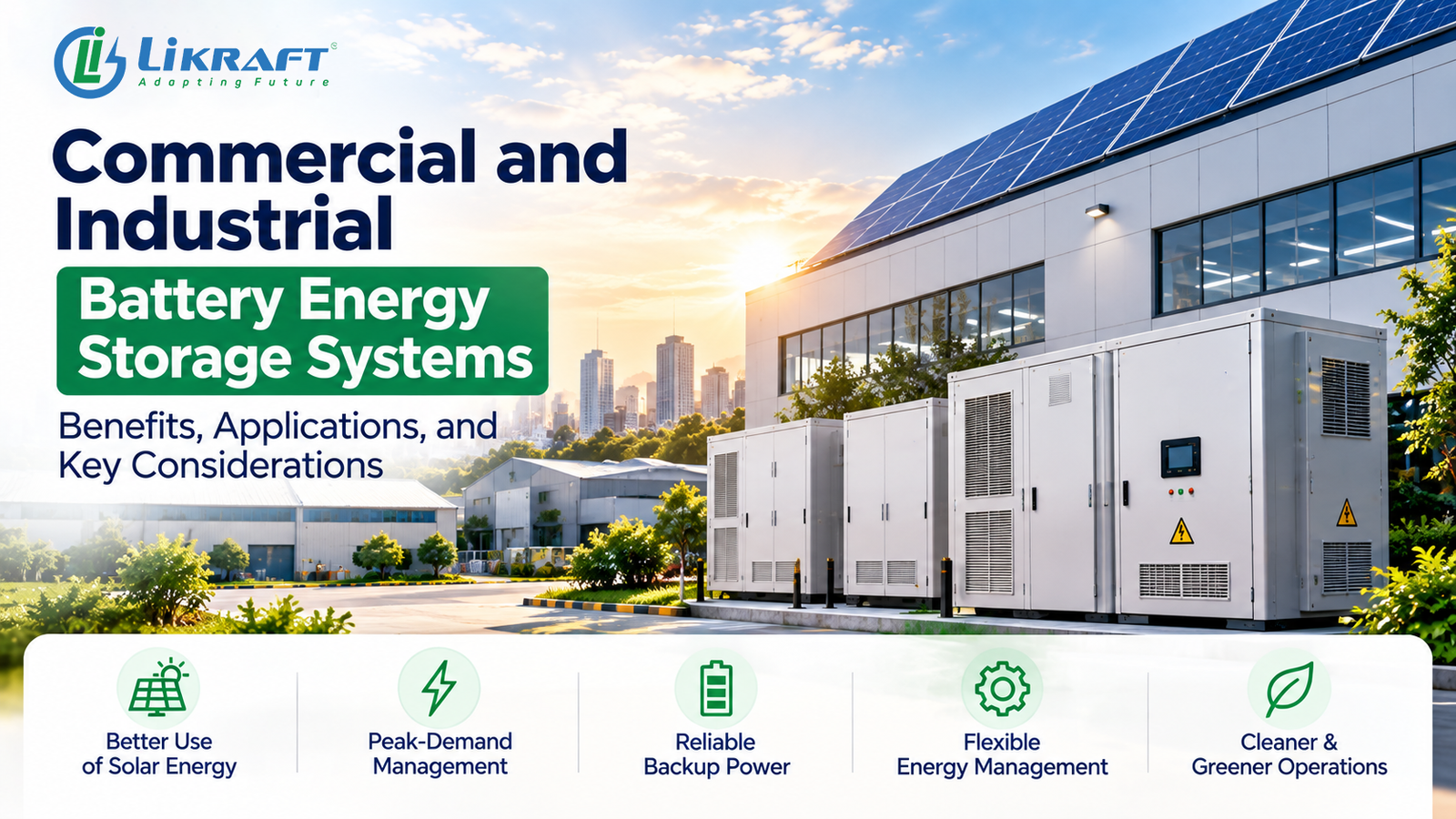
Businesses depend on a reliable power supply to keep operations running smoothly. From manufacturing plants and warehouses to commercial buildings and telecom infrastructure, interruptions in electricity can affect productivity, operating costs, and equipment performance.
This is one reason commercial and industrial battery energy storage systems (C&I BESS) are attracting attention in India’s energy market. These systems can store electricity and release it when required, helping businesses manage energy use, support backup requirements, and make better use of renewable power.
As India’s battery storage market expands, businesses have an opportunity to evaluate how lithium battery energy storage solutions can support their operational needs.
What Is a Commercial and Industrial Battery Energy Storage System?
A commercial and industrial battery energy storage system stores electrical energy for use at a later time. Depending on its design, it can work with the grid, solar power systems, or other energy sources.
A typical battery energy storage system may include:
- Battery modules or packs: Store electrical energy for later use.
- Battery Management System (BMS): Monitors battery parameters and manages protective functions.
- Power Conversion System (PCS): Converts power between AC and DC where required.
- Energy Management System (EMS): Controls charging and discharging based on operating requirements.
- Protection and thermal management: Help maintain suitable operating conditions and protect system components.
The configuration depends on the required power output, storage capacity, installation environment, and intended application.
Why Is Battery Energy Storage Becoming Important in India?
India’s energy storage market is developing alongside the expansion of renewable energy and increasing electricity demand. According to Mercom India Research, India added 8.2 GWh of battery storage capacity in the first half of 2026, bringing cumulative installed capacity to 9.3 GWh by June 2026.
This growth reflects increasing interest in storage for grid balancing, peak-demand management, and renewable energy integration.
For commercial and industrial users, the relevant question is how storage can address a specific operational challenge. A well-designed system may help businesses use stored solar energy, manage selected periods of high electricity demand, or provide backup when configured for that purpose.
Actual savings and performance depend on electricity tariffs, system sizing, operating patterns, and installation costs.
5 Key Benefits of Commercial and Industrial Energy Storage
1. Better Use of Solar Energy
Businesses with rooftop solar installations may generate more electricity during the day than they can use immediately. A suitably sized battery energy storage system can store some of this surplus energy for later use.
This can improve the use of on-site solar generation, particularly when electricity demand continues after solar production decreases.
2. Support for Peak-Demand Management
Some businesses experience short periods of high electricity demand. Depending on the tariff structure and system configuration, stored energy may be discharged during selected peak periods to reduce grid consumption.
This approach is often called peak shaving. Its financial value depends on demand charges, electricity tariffs, battery efficiency, and the cost of operating the storage system.
3. Backup Power for Critical Operations
A battery storage system designed for backup can help supply selected loads during a grid interruption. However, backup capability depends on the inverter or PCS, switching arrangements, protection systems, and the loads connected to the system.
Businesses should identify which equipment must remain operational before choosing a battery capacity.
4. More Flexible Energy Management
Battery storage allows businesses to shift some electricity use from one period to another. When combined with solar generation and a suitable energy management system, it can help coordinate charging and discharging around operating schedules.
This flexibility can be useful for facilities with predictable energy demand or changing electricity tariffs.
5. Support for Renewable Energy Goals
Businesses seeking to increase renewable energy use can consider battery storage as part of a broader energy strategy. Storing surplus solar electricity may help align renewable generation with periods of higher demand.
The environmental benefit depends on the energy sources used for charging, system efficiency, and the overall operating pattern.
How to Choose the Right Lithium Battery Energy Storage System
Selecting a commercial energy storage solution requires more than comparing battery prices or capacities. Consider the following factors before making a decision.
| Selection factor | What to evaluate |
|---|---|
| Energy capacity | Required stored energy, measured in kWh |
| Power rating | Maximum power the system must deliver, measured in kW |
| Backup duration | How long critical loads must operate |
| Battery chemistry | Suitability for the required performance and operating conditions |
| Inverter compatibility | Electrical ratings, controls, and communication requirements |
| BMS and monitoring | Protection functions, system data, and fault reporting |
| Installation conditions | Temperature, ventilation, space, and protection requirements |
| Service and warranty | Applicable coverage, maintenance, and technical support |
It is important to distinguish between kW and kWh. Kilowatts describe power, while kilowatt-hours describe stored energy. A system’s required energy capacity depends on the load and the duration for which it must operate.
For example, a facility requiring 20 kW for two hours would need 40 kWh of usable energy before accounting for conversion losses, reserve capacity, and other system limitations.
Why LiFePO₄ Batteries Are Used in Energy Storage Systems
Lithium iron phosphate (LiFePO₄, or LFP) is a lithium-ion battery chemistry commonly considered for stationary energy storage.
Its characteristics include good thermal stability and the potential for long cycle life under suitable operating conditions. These properties can make it a candidate for commercial, industrial, solar, and telecom applications.
However, actual battery performance depends on cell quality, pack design, the BMS, temperature, charge and discharge rates, and operating conditions. Buyers should compare cycle-life specifications using the stated test conditions rather than treating a cycle-life figure as a guaranteed service life.
How Likraft Supports Battery Energy Storage Requirements
Likraft Batteries Pvt. Ltd. provides lithium battery pack solutions for energy storage, solar, telecom, EV, and industrial applications.
Businesses evaluating a battery energy storage solution should consider their load profile, required backup duration, installation space, electrical compatibility, and monitoring requirements before selecting a configuration.
Likraft’s range includes energy storage battery options for different applications, with specifications and integration requirements varying by product. Businesses can discuss their requirements with the Likraft team to identify a suitable battery pack solution.
Conclusion
Commercial and industrial battery energy storage systems can help businesses make better use of solar power, manage selected periods of high demand, and support critical loads when appropriately configured.
The right solution starts with a clear understanding of energy consumption, operating requirements, and expected financial benefits. By evaluating battery chemistry, usable capacity, power rating, system compatibility, and service support, businesses can make a more informed decision.
Looking for lithium battery solutions for your energy storage project? Contact Likraft to discuss your application and technical requirements.
Send us an email at info@likraft.com.
Address: Rai Industrial Area, Sonipat, Haryana