


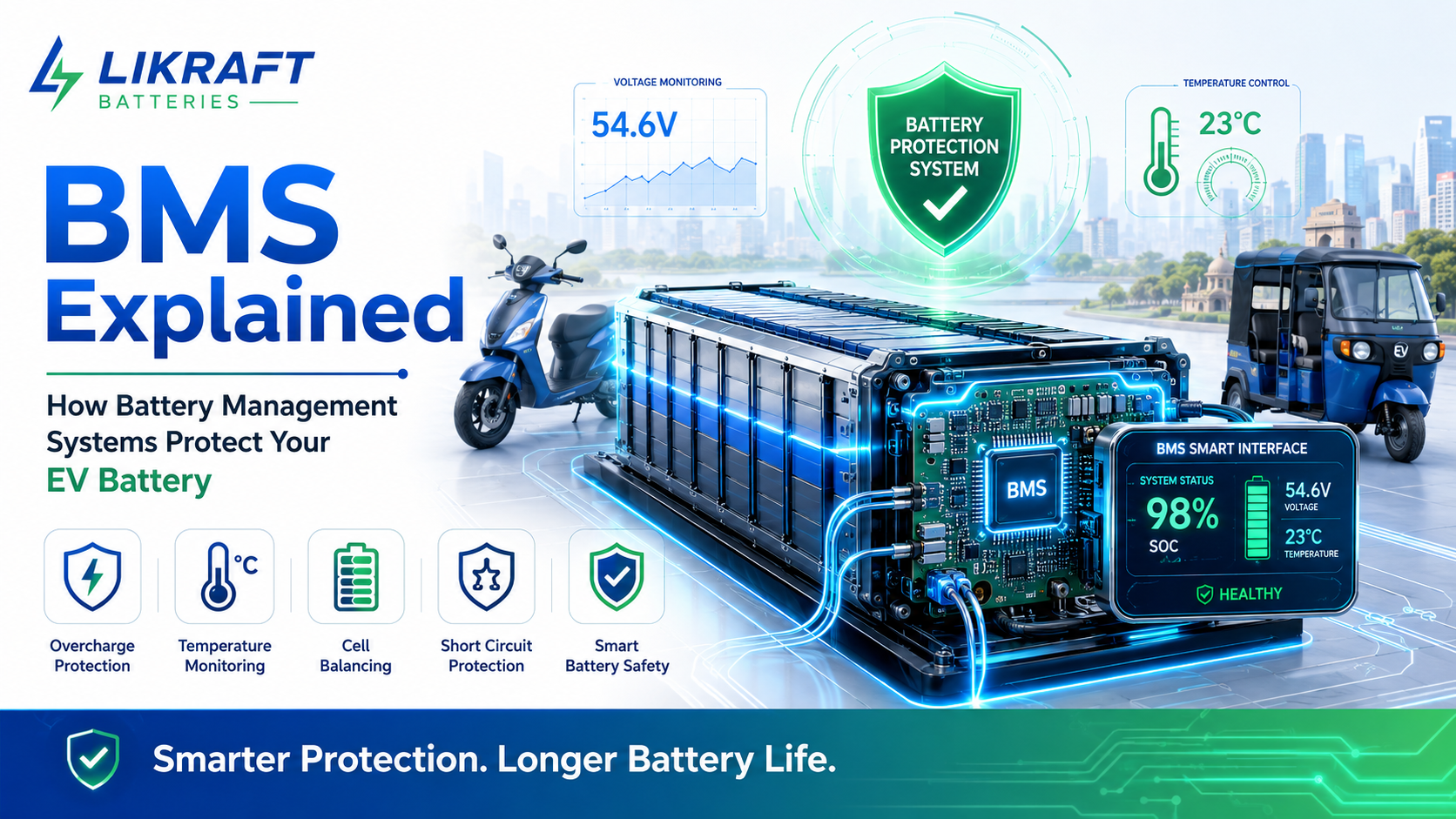
Electric vehicles are changing the future of mobility in India, and lithium batteries are at the center of this transformation. But behind every reliable lithium battery is a smart protection system working continuously in the background, the Battery Management System, commonly known as BMS.
A BMS is one of the most important components inside an EV lithium battery pack. It helps monitor battery health, controls charging and discharging, and protects the battery from unsafe operating conditions.
At Likraft Batteries Pvt. Ltd., we focus on advanced lithium battery solutions designed for safety, reliability, and long-term performance. Understanding the role of a BMS helps users make smarter decisions about EV battery usage and maintenance.
What Is a Battery Management System (BMS)?
A battery management system is an electronic monitoring and protection system installed inside a lithium battery pack.
Its primary role is to:
- Protect battery cells
- Monitor voltage and temperature
- Control charging and discharging
- Improve battery safety
- Support longer battery life
The BMS acts as the “brain” of the battery system, ensuring the battery operates within safe limits at all times.
Why Is BMS Important in EV Batteries?
Lithium batteries are highly efficient, but they also require precise control and monitoring.
In EV applications such as:
- E-rickshaws
- Electric scooters
- Electric bikes
- EV fleets
The battery experiences frequent charging cycles, varying loads, and changing temperatures. A BMS helps manage these conditions safely and efficiently.
Without a proper BMS, lithium batteries may face:
- Overcharging
- Deep discharge
- Overheating
- Voltage imbalance
- Reduced battery lifespan
Main Functions of a Battery Management System
Overcharge Protection
Charging a lithium battery beyond its recommended voltage can damage battery cells.
The BMS automatically controls charging and stops excess charging when required. This helps improve battery safety and lifespan.
Deep Discharge Protection
Completely draining a lithium battery repeatedly can affect battery health.
The BMS protects the battery by limiting discharge when voltage levels become too low.
Temperature Monitoring
Temperature directly affects lithium battery performance.
The BMS continuously monitors battery temperature during:
- Charging
- Heavy usage
- Fast acceleration
- Continuous operation
If the temperature rises beyond safe limits, the system takes protective action.
Cell Balancing
A lithium battery pack contains multiple cells working together.
Over time, some cells may charge or discharge unevenly. The BMS balances the cells to maintain equal voltage levels across the battery pack.
This helps:
- Improve charging efficiency
- Maintain stable performance
- Increase battery life
Short Circuit Protection
Short circuits can damage battery components and create safety risks.
The BMS instantly disconnects the battery during abnormal current flow conditions to protect the system.
Current Control
EV batteries experience different power demands during acceleration and charging.
The BMS manages current flow to protect battery cells from excessive stress.
How BMS Improves EV Battery Performance
A high-quality BMS helps improve:
- Battery lifespan
- Charging stability
- Safety during operation
- Overall energy efficiency
- Long-term reliability
It also reduces the chances of unexpected battery failures and performance drops.
Common Signs of BMS Problems
In some cases, BMS-related issues may affect battery performance.
Common signs include:
- Battery not charging properly
- Sudden power cut-off
- Reduced driving range
- Unusual heating
- Charging interruptions
- Inconsistent performance
If these issues continue, professional inspection is recommended.
Applications of BMS Technology
Battery Management Systems are widely used in:
- Electric vehicles
- Solar energy storage systems
- Telecom backup solutions
- Industrial lithium battery applications
- Inverter systems
Modern lithium battery technology depends heavily on intelligent BMS protection.
Battery vs BMS: Understanding the Difference
| Battery | BMS |
|---|---|
| Stores electrical energy | Protects and monitors the battery |
| Provides power output | Controls battery safety functions |
| Made of lithium cells | Made of sensors and electronic circuits |
| Handles energy storage | Handles battery management |
Why Smart BMS Technology Matters
As EV adoption continues to grow in India, battery safety and performance have become more important than ever.
A smart BMS helps:
- Improve battery durability
- Support safe charging
- Prevent overheating
- Maintain consistent performance
- Reduce maintenance issues
This makes the battery system more reliable for daily EV usage.
Conclusion
A battery management system is one of the most critical parts of a lithium battery pack. It protects the battery from unsafe conditions, improves efficiency, and supports long-term performance.
From temperature monitoring to overcharge protection and cell balancing, the BMS ensures EV batteries operate safely and reliably every day.
Choosing a lithium battery with a strong and intelligent BMS is essential for better safety, improved battery life, and dependable EV performance.
Send us an email at info@likraft.com
Address: Rai Industrial Area, Sonipat, Haryana